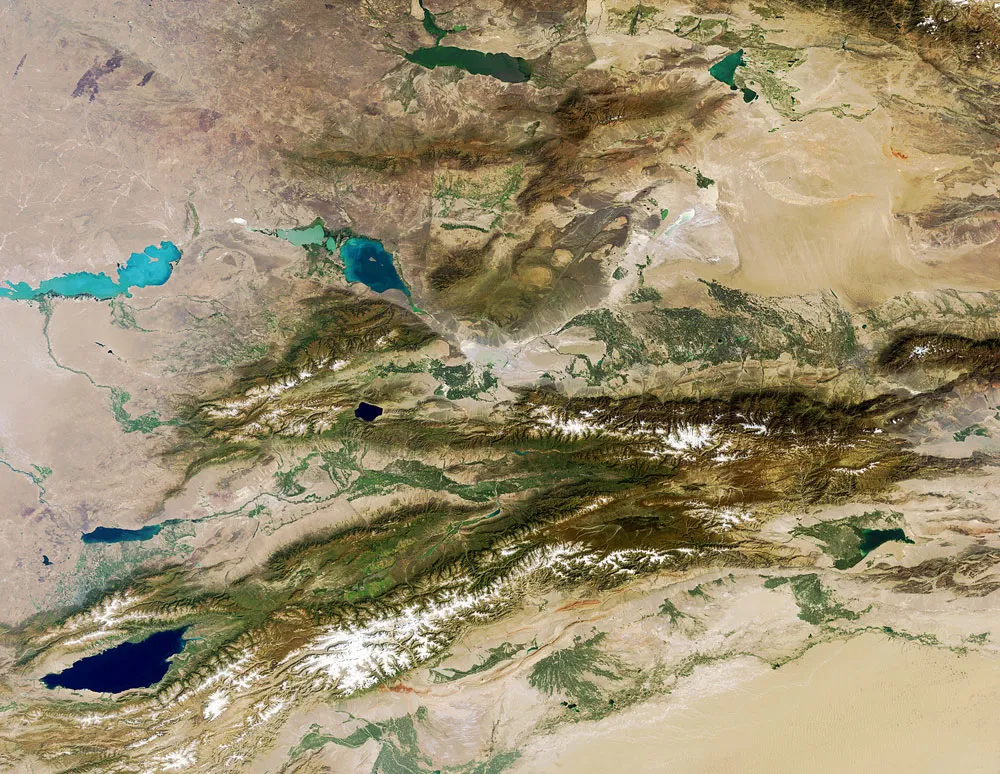
View from Space: Bumpy Border Region
Get the world’s most fascinating discoveries delivered straight to your inbox.
You are now subscribed
Your newsletter sign-up was successful
Want to add more newsletters?
Delivered Daily
Daily Newsletter
Sign up for the latest discoveries, groundbreaking research and fascinating breakthroughs that impact you and the wider world direct to your inbox.
Once a week
Life's Little Mysteries
Feed your curiosity with an exclusive mystery every week, solved with science and delivered direct to your inbox before it's seen anywhere else.
Once a week
How It Works
Sign up to our free science & technology newsletter for your weekly fix of fascinating articles, quick quizzes, amazing images, and more
Delivered daily
Space.com Newsletter
Breaking space news, the latest updates on rocket launches, skywatching events and more!
Once a month
Watch This Space
Sign up to our monthly entertainment newsletter to keep up with all our coverage of the latest sci-fi and space movies, tv shows, games and books.
Once a week
Night Sky This Week
Discover this week's must-see night sky events, moon phases, and stunning astrophotos. Sign up for our skywatching newsletter and explore the universe with us!
Join the club
Get full access to premium articles, exclusive features and a growing list of member rewards.
One of the longest mountain ranges in Central Asia, the Tian Shan mountain range, forms a bumpy border between Kazakhstan, Kyrgyzstan and western China.
The Tian Shan, seen here in a picture taken by the recently defunct Envisat satellite, are about 1,740 miles (2,800 kilometers) long.
At altitudes over about 6,500 feet (2,000 meters), spruce trees grow on the mountain slopes, while the lower slopes have natural forests of wild walnuts and apples.
The large, dark lake that splits the mountain range in eastern Kyrgyzstan (in the lower-left corner of the image) is the second largest salt lake after the Caspian Sea. The lake is called Issyk Kul – 'hot lake' in the Kyrgyz language — because it never freezes over. It covers an area of over 2,300 square miles (6,000 square km) and reaches over 1,900 feet (600 m) deep.
The area was a stopover along the ancient Silk Road, a trading route that ran from the Far East to Europe. Some historians think it was the starting point of the Black Death in the 14th century.
Get the world’s most fascinating discoveries delivered straight to your inbox.