














Astronauts Catch Glimpse of 'Sunglint' Off Massachusetts Coast

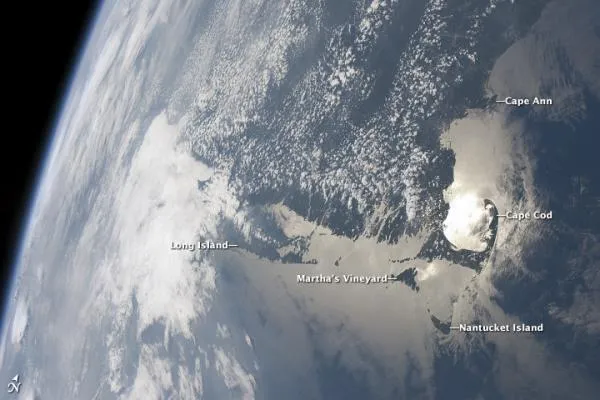
Each day, the Crew Earth Observations team at NASA's Johnson Space Center sends specific ground targets for photography to astronauts on the International Space Station (ISS). But sometimes the striking displays visible from orbit provoke the crew to take imagery on their own. One such display often visible to the ISS crew due to their ability to look outwards at angles between 0 and 90 degrees is sunglint on the waters of Earth . Sunglint is caused by sunlight reflecting off of a water surface directly towards the observermuch as light reflects from a mirror. Variations in the roughness of the water surface scatter the light, blurring the reflection and producing the silvery sheen of a sunglint area.
The point of maximum sunglint in this image is centered within Cape Cod Bay, the body of water partially enclosed by the "hook" of Cape Cod in Massachusetts (image right). (The U.S. Congress authorized the creation of Cape Cod National Seashore fifty years ago, in August 1961). Sunglint off the water provides sharp contrast with the coastline and the nearby islands of Martha's Vineyard and Nantucket, both popular destinations for tourists and summer residents. To the north, rocky Cape Ann extends into the Atlantic Ocean; the border with New Hampshire is located approximately 30 kilometers (18 miles) up the coast.
Further to the west, the eastern half of Long Island, New York, emerges from extensive cloud cover over the mid-Atlantic and Midwestern States. Persistent storm tracks had been contributing to record flooding in the Midwest at the time this image was taken in late June 2011. Thin blue layers of the atmosphere, contrasted against the darkness of space, are visible along the Earth's curvature at image left.
Get the world’s most fascinating discoveries delivered straight to your inbox.
