














An Astronaut's View of a Dangerous Volcano

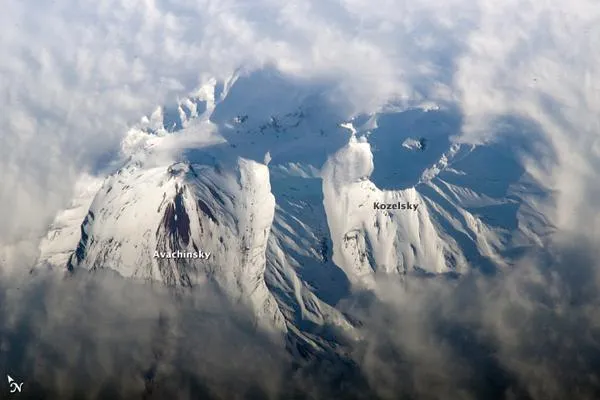
The Kamchatka Peninsula of Russia, located along the Pacific ring of fire , includes more than 100 volcanoes. While most of these volcanoes are not actively erupting, many are considered dangerous due to their eruptive history and their proximity to population centers and air travel corridors. This astronaut photograph highlights the summit crater and snow-covered slopes of the Avachinsky stratovolcano as it pokes above a surrounding cloud deck.
The 2,741 meter (8,993 foot) high Avachinsky volcano has an extensive historical and geological record of eruptions. The latest activity occurred in 2008.
The large city of Petropavlovsk, Kamchatka , is located approximately 25 kilometers (15 miles) to the southwest and is built over approximately 30,00040,000 year old debris deposits from an avalanche that originated at Avachinskysuggesting that the city may be at risk from a similar hazard in the future. To the southeast (image right), the large breached crater of Kozelsky Volcano is also visible above the clouds. Kozelsky is a parasitic cone, formed by the eruption of material from vents along the flank of Avachinsky.
The topography of the volcanoes is accentuated by shadows caused by the relatively low sun angle, and by the oblique viewing angle. Oblique images are taken looking outwards from the International Space Station, rather than the straight down (or nadir) view typical of most Earth-observing sensors.
Get the world’s most fascinating discoveries delivered straight to your inbox.
