














See Sunset from an Astronaut's Perspective

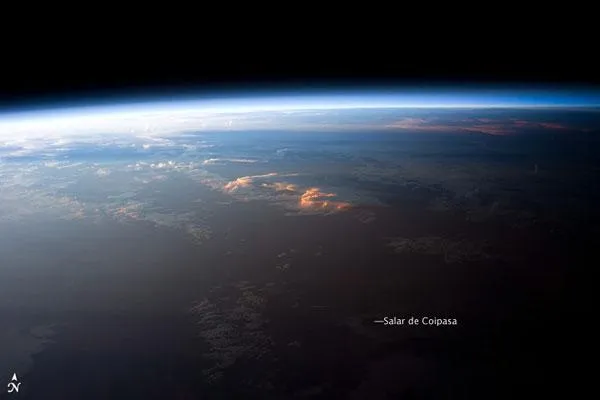
Astronauts onboard the International Space Station see the Earth from a unique perspective -- for example, in one 24-hour period, they see not one sunrise and sunset, but 16 on average.
Each changeover between day and night is marked by the terminator, a line on Earth's surface separating the sunlit side from the darkness.
While the terminator is often conceptualized as a hard boundary, in reality the edge of light and dark is diffuse due to the scattering of light by the Earth's atmosphere . This zone of diffuse lighting is experienced as dusk or twilight on the ground; while the Sun is no longer visible, some illumination is still present due to light scattering over the local horizon.
The terminator is visible in this panoramic view across central South America, looking towards the northeast. An astronaut shot the photo at approximately 7:37 p.m. local time.
Layers of the Earth's atmosphere , colored bright white to deep blue, are visible on the horizon (or limb). The highest cloud tops have a reddish glow due to direct light from the setting sun, while lower clouds are in twilight.
The Salar de Coipasa, a large salt lake in Bolivia, is dimly visible on the night side of the terminator. The salar provides a geographic reference point for determining the location and viewing orientation of the image.
Get the world’s most fascinating discoveries delivered straight to your inbox.
