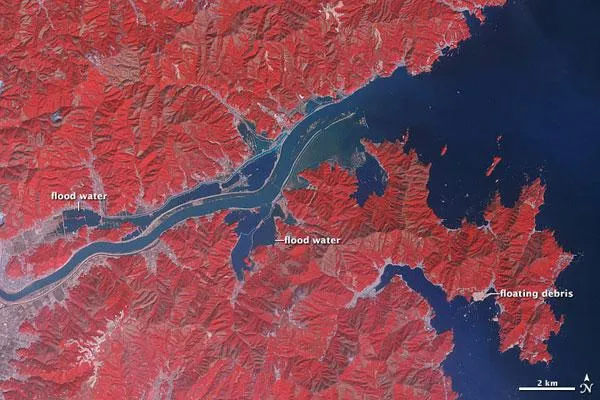
Tsunami Flooded Japanese River
Get the world’s most fascinating discoveries delivered straight to your inbox.
You are now subscribed
Your newsletter sign-up was successful
Want to add more newsletters?
Delivered Daily
Daily Newsletter
Sign up for the latest discoveries, groundbreaking research and fascinating breakthroughs that impact you and the wider world direct to your inbox.
Once a week
Life's Little Mysteries
Feed your curiosity with an exclusive mystery every week, solved with science and delivered direct to your inbox before it's seen anywhere else.
Once a week
How It Works
Sign up to our free science & technology newsletter for your weekly fix of fascinating articles, quick quizzes, amazing images, and more
Delivered daily
Space.com Newsletter
Breaking space news, the latest updates on rocket launches, skywatching events and more!
Once a month
Watch This Space
Sign up to our monthly entertainment newsletter to keep up with all our coverage of the latest sci-fi and space movies, tv shows, games and books.
Once a week
Night Sky This Week
Discover this week's must-see night sky events, moon phases, and stunning astrophotos. Sign up for our skywatching newsletter and explore the universe with us!
Join the club
Get full access to premium articles, exclusive features and a growing list of member rewards.
In the wake of the magnitude 9.0 earthquake and resulting tsunami that struck northeastern Japan last Friday (March 11), ocean waters flooded croplands and settlements lining the Kitakami River.
The Advanced Spaceborne Thermal Emission and Reflection Radiometer (ASTER) on NASA's Terra satellite captured these false-color images before and after the tsunami . Above is the after image, taken on Monday (March 14); below is the before image, taken on Jan. 16.
The images combine infrared, red, and green wavelengths of light to form a false-color image that distinguishes between muddy water and land. Water is blue. Buildings and paved surfaces appear in shades of blue-gray. Fallow fields appear in shades of beige and brown. Vegetation is red, and the brighter the red, the more robust the vegetation. (Brighter shades of red in March and duller shades in January result largely from the difference in season.)
In the March image, water has spilled over the banks both north and south of the river. Although agricultural fields appear to have escaped the flooding farther inland (image left), some fields closer to the ocean have seemingly disappeared into the sea, a NASA statement said.
North of the Kitakami, floodwaters extend far enough inland to create what looks like a parallel river. Near the coast, only the rugged peaks rising above the floodplains have escaped inundation.
- Video: Before and After the Tsunami
- In Pictures: Japan Earthquake and Tsunami
- 7 Ways the Earth Changes in the Blink of an Eye
Get the world’s most fascinating discoveries delivered straight to your inbox.