














Path to the Summit of Mount Everest

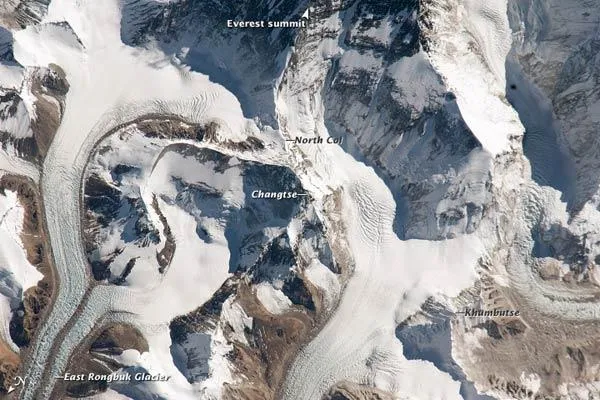
This astronaut photograph highlights the northern approach to Mount Everest from Tibet (China).
Known as the northeast ridge route, climbers travel along the East Rongbuk Glacier (image lower left) to camp at the base of Changtse mountain.
From this point at approximately 20,000 feet (6,100 meters) above sea level , climbers ascend the North Col a sharp-edged pass carved by glaciers, at image center to reach a series of progressively higher camps along the North Face of Everest.
Climbers make their final push to the summit (just off the top edge of the image) from Camp VI at 27,000 feet (8,230 meters) altitude.
Located within the Himalaya mountain chain , Everest (or Sagarmatha in Nepali) is the Earth's highest mountain, with its summit at 29,029 feet (8,848 meters) above sea level. Khumbutse mountain, visible at the lower right, has a summit elevation of 21,785 feet (6,640 meters).
Climbing to the summit of Everest requires much advance planning, conditioning, and situational awareness on the part of mountaineers to avoid potentially fatal consequences. As of 2010, there have been over 200 reported deaths.
The numerous expeditions to reach the summit of Everest have produced significant trash and spent oxygen bottles at the various camps, leading the Nepalese government to impose rules requiring climbers to return with their gear and rubbish. Several "cleanup" expeditions have removed tons of material, including the remains of several climbers .
Get the world’s most fascinating discoveries delivered straight to your inbox.
