














Weird Glow from Earth's Auroras Explained
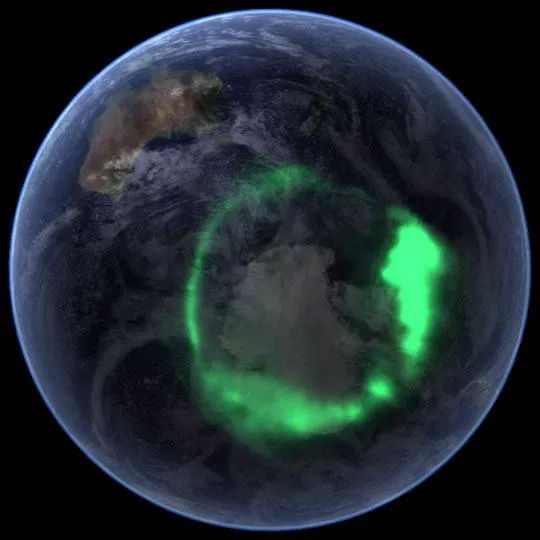
The mystery behind the faint glow of light in Earth's upper atmosphere, known as the diffuse aurora, has been found, scientists say.
A special kind of radio wave is at work behind the scenes to put on the auroras that form the northern and southern lights, a new study finds.
These aurora-triggering waves are called chorus waves because their signals sound like a bird's dawn chorus when played through a loud speaker. Past studies have shown these waves can also cause Earth's auroras to pulse as well as glow diffusely.
The new study, detailed in the Oct. 21 issue of the journal Nature, shows that chorus waves are responsible for scattering electrons that are trapped in space and dumping them down into the atmosphere to create the diffuse aurora. [Graphic: Earth's Atmosphere Top to Bottom ]
Not your average aurora
The diffuse aurora is not the same as the discrete aurora more popularly known as the northern and southern lights. Discrete aurora look like fiery moving curtains of colorful light and can be seen by the naked eye, whereas the diffuse aurora is much fainter but more extensive.
The diffuse aurora, which typically accounts for three-quarters of the energy input into the upper atmosphere at night, varies according to the season and the 11-year solar cycle. Because it is so spread out, the diffuse aurora is not usually visible to the naked eye.
Get the world’s most fascinating discoveries delivered straight to your inbox.
A separate study recently discovered that chorus waves are also responsible for a rare kind of aurora that flickers on and off, called the pulsating aurora. While the types of auroras differ, both studies report that chorus waves are the cause, so they support each other, said Richard Horne, a co-author on the diffuse aurora study, from the British Antarctic Survey in Cambridge, England.
Trapped electrons
The diffuse aurora is caused by electrons striking the upper atmosphere that much was already known but how they get there was not clear. The electrons are normally trapped much higher up in the Earth's magnetic field.
The new research used computer models to calculate how fast the electrons are scattered by different kinds of waves and how many electrons would be left behind trapped in the magnetic field.
"The real clincher was when we examined the distribution of electrons left behind in space which resembled a pancake very flat and peaked in a direction across the magnetic field direction," Horne told OurAmazingPlanet, a sister site of SPACE.com. "Only chorus waves could produce the 'pancake' distribution."
Horne said that their finding "is an important one because it will help scientists to understand how the diffuse aurora leads to changes in the chemistry of the Earth's upper atmosphere , including effects on ozone at high altitude, which may affect temperature right through the atmosphere."
The link between chorus waves and auroras should also benefit satellite, power grid and aviation industries, Horne said, by improving GPS navigation and high frequency radio communications with aircraft on polar routes.