














Europe's New Space Weather Center to Track Sun Storms

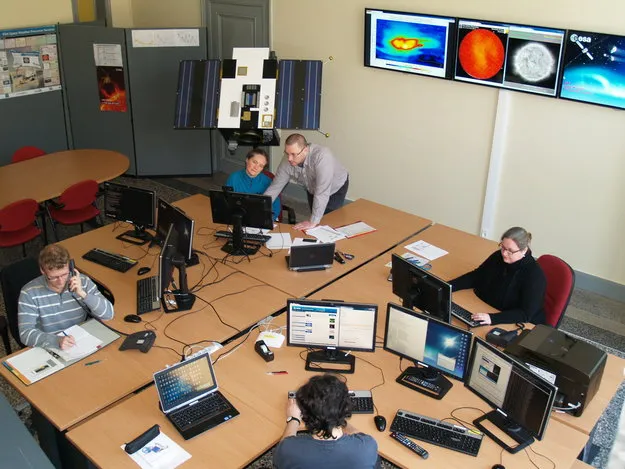
The European Space Agency opened a new space weather center last week in Brussels to keep tabs sun storms that could interfere with satellites in orbit and power grids on Earth.
Formally inaugurated on April 3, the Space Weather Coordination Centre (SSCC) will gather information on sun storms as well as disturbances in our planet's geomagnetic environment and ionosphere. Experts at the center will issue alerts and provide support for satellite operators, government agencies and research institutes whose work might be affected by space weather, according to a statement from ESA.
The SSCC, housed in the Royal Observatory of Belgium, is part of ESA's Space Situational Awareness (SSA) program, which keeps track of hazards like space junk and potentially dangerous asteroids that pose a threat to Earth and its systems in orbit.
"With the SSCC inauguration, our SSA Programme is taking concrete steps to develop a European capability to operationally monitor space weather, enhance international cooperation and establish the effective distribution of information, warnings and alerts to users in economically vital sectors," Thomas Reiter, ESA's head of human spaceflight and operations, said in a statement.
"The SSCC will help to get the right information to the right people at the right time," Reiter added.
In the United States, the Space Weather Prediction Center, a division of the National Oceanic and Atmospheric Administration (NOAA), is the official source of space weather alerts, watches and warnings.
This story was provided by SPACE.com, sister site to Live Science. Follow SPACE.com on Twitter @Spacedotcom. We're also on Facebook and Google+.
Get the world’s most fascinating discoveries delivered straight to your inbox.
