















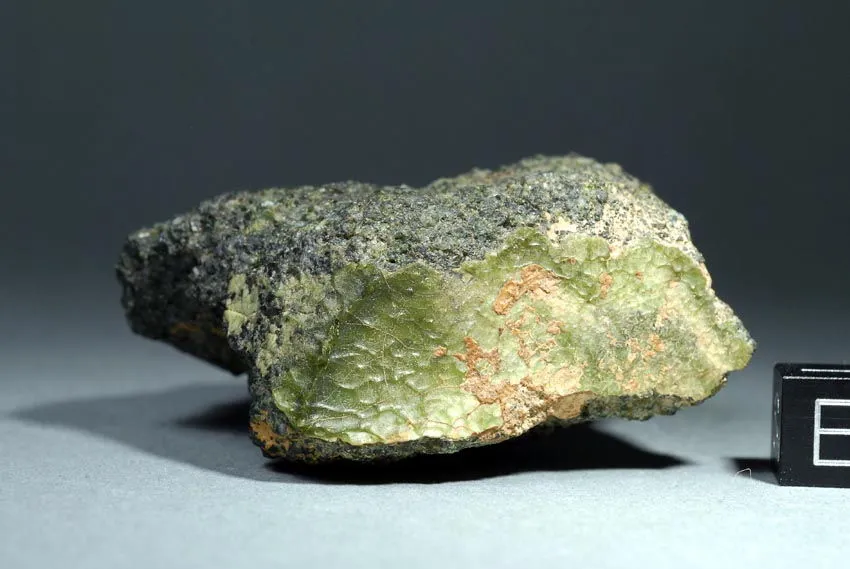
A strange green space rock hailed as perhaps the first meteorite ever discovered from Mercury may be too old to have come from the solar system's innermost planet, some scientists say.
Last month, scientists announced that the green-hued meteorite NWA 7325 shares many chemical similarities with Mercury, suggesting it may be the first known visitor from the small, sun-scorched planet.
But NWA 7325's advanced age — it's thought to be more than 4.5 billion years old — casts some doubt on this interpretation, some scientists have stressed, citing the example of Earth's moon to help make their point.
"The moon began to crystallize 4.5 billion years ago, but we don't have any 4.5-billion-year-old meteorites from the moon, because all of those rocks would have been bashed to smithereens during the Late Heavy Bombardment that pockmarked the moon with craters between 4 to 3.8 billion years ago," meteorite expert Randy Korotev, of Washington University in St. Louis, said in a statement.
“The same thing would have happened on Mercury, so the question is, How did this rock survive for that long?" Korotev added. "There's no sign of it being brecciated, or busted up."
Still, Korotev doesn't rule out the possibility that NWA 7325, which was found in Morocco last year, is indeed from Mercury. Further tests could help researchers get a better sense of the meteorite's origins, he added.
A test with the potential to be particularly informative would assess NWA 7325's levels of "cosmogenic radionuclides," unstable atoms generated by exposure to cosmic radiation.
Get the world’s most fascinating discoveries delivered straight to your inbox.
"If this stone had exceedingly high cosmogenic nuclides, that would be an argument for it coming from Mercury, because Mercury is so close to the sun," Korotev said.
While NWA 7325's exact provenance remains unclear at the moment, scientists do know something about its origins. The meteorite is an achondrite, a relatively rare type of space rock that comes from a planet or big asteroid — something large that generated enough internal heat early in its history to melt partially, producing a metallic core surrounded by rock.
And researchers have a pretty good idea of where its green color comes from.
"I once analyzed bottles to see what made them blue or green," Korotev said. "The greenest bottle had 660 parts per million chromium, but some of the mineral components of NWA 7325 have 7,000 parts per million chromium. That's why it's green."
This story was provided by SPACE.com, sister site to Live Science. Follow Mike Wall on Twitter @michaeldwall. Follow us @Spacedotcom, Facebook or Google+. Originally published on SPACE.com.
