
Why We're Giving Bald Eagles Onboard GPS
Bryan Watts, director of the Center for Conservation Biology at the College of William & Mary and Virginia Commonwealth University, contributed this article to LiveScience.com's Expert Voices: Op-Ed & Insights.
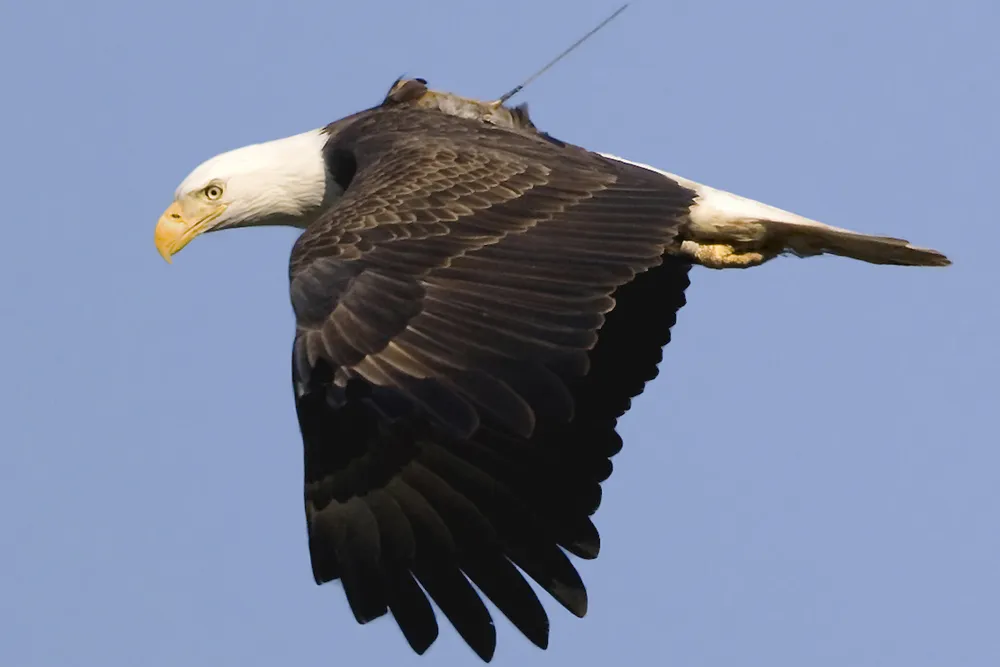
Beginning in the summer of 2007, the Center for Conservation Biology (CCB) began deploying satellite transmitters with onboard GPS receivers on bald eagles within the Chesapeake Bay region. Most of those transmitters were deployed as part of a large Department of Defense (DOD) study. The DOD is interested in the birds because military bases often provide great cover for eagles. Unfortunately, eagles don't come out too well where there is ordnance testing, and the birds also run afoul of power lines and other installations. The purpose of the large DOD study is to prioritize mitigation of those hazards.
Article continues below 
The value of the tracking dataset to eagle conservation — and its contribution to our understanding of eagle ecology — is immeasurable. Understanding patterns in eagle movement across the landscape is key to the responsible placement of hazards such as power lines, wind turbines and cell towers, and for avoiding bird-aircraft collisions near airports.
Hidden within this dataset are migratory pathways that eagles have used throughout the Northeast for thousands of years, seasonal patterns of foraging locations and revelations for how birds move along local stream corridors.
To many of us at the CCB, the most exciting aspects of the tracking dataset are the movement patterns of young eagles. We're following the movement of 20 young individuals that were marked as nestlings. Soon, many of those birds will have been tracked over their entire juvenile period — from the nest where they were hatched to the nest where they will breed.
This crucial period within the eagle life cycle is the one for which we have the least information and understanding. The tracking dataset has the potential to answer many questions about the ecology of eagles in their first five years before breeding.
You can follow any one of our tracked eagles. Pick from the list here. Stay tuned as information from the tracking dataset is used to discover many new aspects of eagle ecology.
The views expressed are those of the author and do not necessarily reflect the views of the publisher. Read Watts's most recent Expert Voices piece, Wanted: Osprey Watchers as Citizen-Scientists.