













Ancient Wine Press Possibly Found Under Tel Aviv City Street

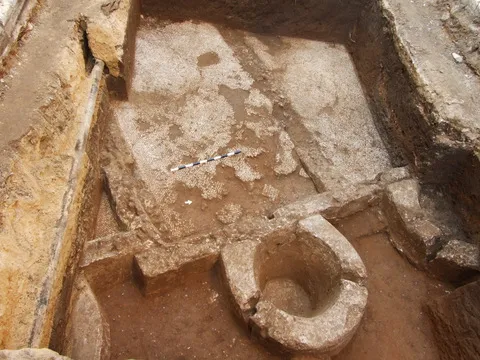
Archaeologists have revealed what could be part of a 1,500-year-old wine-making factory underneath a street in the ancient city of Jaffa, now part of Tel Aviv, the Israel Antiquities Authority (IAA) announced.
Researchers think the installation dates back to the second half of the Byzantine period, around the sixth to early seventh centuries A.D. Its smooth, mosaic surfaces suggest it was used in the production of some kind of liquid.
"Due to the mosaic's impermeability, such surfaces are commonly found in the press installations of the period, which were used to extract liquid," Yoav Arbel, director of the IAA excavations, said in a statement. "Each unit was connected to a plastered collecting vat. The pressing was performed on the mosaic surfaces whereupon the liquid drained into the vats."
These archaeological features are often identified as wine presses, used to squeeze juice from grapes. But Arbel told Israel's Haaretz newspaper that wine presses generally have larger collecting pits than this one. It is possible then that the installation could have been used to make wine or alcoholic beverages from smaller fruits, such as pomegranates, figs or dates. Alternatively, it could have been used to make paint, Arbel told Haaretz.
Arbel said he believes the section discovered could be a small part of a much larger installation that may be uncovered with further excavations along nearby streets later this year.
"This is the first important building from the Byzantine period to be uncovered in this part of the city," Arbel said in an IAA statement. He added that the installation is relatively far outside of Jaffa's ancient archaeological mound, which "adds a significant dimension to our knowledge about the impressive agricultural distribution in the region in this period."
Follow LiveScience on Twitter @livescience. We're also on Facebook & Google+.
Get the world’s most fascinating discoveries delivered straight to your inbox.
