













Solitary Hyenas Still Get the Last Laugh
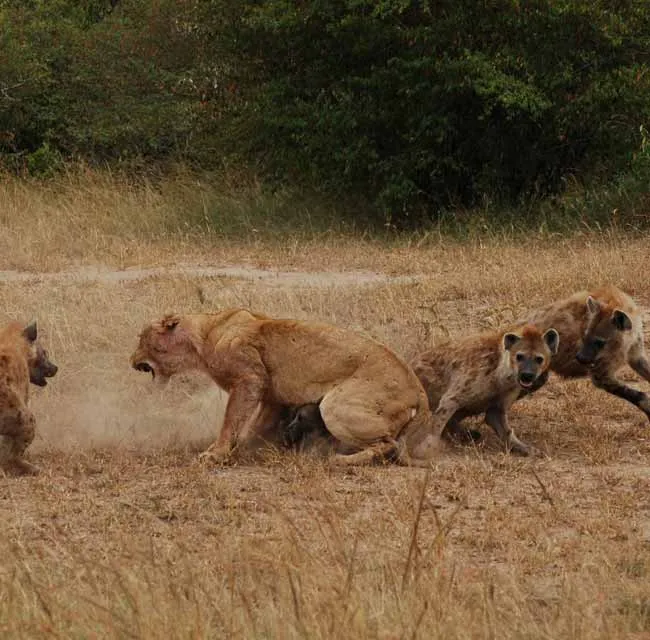
Spotted hyenas lived as solitary scavengers over a million years ago. But over time, they have become more of a communal species.
New research indicates that, to offset the cost of competition among the group, spotted hyenas still demonstrate an ancestral tendency to separate themselves when searching for their next meal.
Hyenas do find some strength in numbers in several ways. They may engage in turf battles with other local hyenas. Tracking down a meal is certainly easier as a group effort – spotted hyenas are 20 percent more likely to capture prey if they have help. And this collective approach then bodes well when defending their newly acquired food from lions.
But with these advantages come drawbacks as well. Additional help before the kill translates into additional competition afterwards. And with a well-established hierarchy, the spotted hyenas higher up the ladder get their meal while others suffer.
Consequently, hyenas still head out for food but later return to their community. This cyclic process of splitting up and then reuniting, similar to humans who return home after work, is referred to as fission-fusion dynamics.
Jennifer Smith, a doctoral zoology student at Michigan State University, recently published a paper in the journal Animal Behavior that offers these results. She based her work on research performed at Masai Mara National Reserve in Kenya.
- Top 10 Deadliest Animals
- Top Predators Key to Ecosystem Survival, Study Shows
- The Painful Realities of Hyena Sex
Get the world’s most fascinating discoveries delivered straight to your inbox.