













Ancient Reptiles Had Parachutes

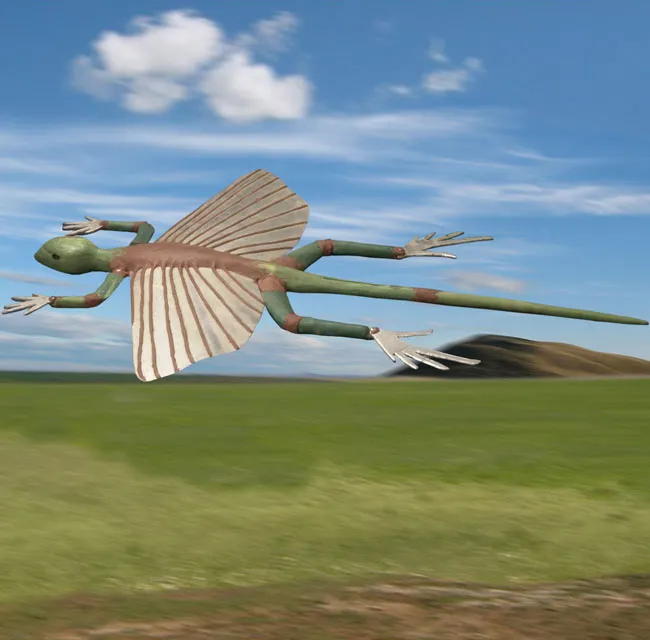
The Jurassic Period's Archaeopteryx is famous as the world's first known bird, but now-extinct reptiles such as pterosaurs and kuehneosaurs were flying as far back as 225 million years ago, during the Triassic and before large dinosaurs roamed the Earth.
A lot of strange creatures took to the air back then. Some large flying reptiles fed on dinosaurs. One early dinosaur appears to have been the first biplane.
Other small reptiles that seemed to have wings had remained largely mysterious, however.
Now scientists say the smaller creatures soared between trees on strange fly-like wings and parachutes. They glided like today's flying dragons, small lizards that can extend membranes attached to movable ribs to glide short distances between trees.
The new study of kuehneosaurs, by scientists from the University of Bristol, England, shows that smaller reptiles used extraordinary extensions of their ribs to form large gliding surfaces on the side of the body. The results are detailed in the July 15 issue of the journal Palaeontology.
Kuehneosaurs, up to two feet (70 centimeters) long, were first found in the 1950s in an ancient cave system near Bristol. Their lateral wings were always assumed to be some form of flying adaptation, but their aerodynamic capability had never been studied before.
Koen Stein, who did the work while a graduate at Bristol University, has shown that of the two genera found in Britain, Kuehneosuchus was a glider (it has elongated wings), while Kuehneosaurus, with much shorter "wings," was a parachutist. As the two forms are so alike in other respects, it is possible that they are males and females of the same animal.
Get the world’s most fascinating discoveries delivered straight to your inbox.
"We didn't think kuehneosaurs would have been very efficient in the air, but all the work up to now had been speculation, so we decided to build models and test them in the wind tunnel in the Department of Aerospace Engineering at Bristol," Stein said.
"Surprisingly, we found that Kuehneosuchus was aerodynamically very stable," Stein said. "Jumping from a five-meter [about 5.5 yards] tree, it could easily have crossed nine meters [about 10 yards] distance before landing on the ground. The other form, Kuehneosaurus, was more of a parachutist than a glider."
To work out how these creatures controlled their flight, the researchers had to model different skin flaps over the wing area.
"We also built webbed hands and feet and had an extra skin membrane between the legs on the models, but these made the flight of the animals unstable, suggesting that they probably did not have such features," Stein said.
- Dinosaurs That Learned to Fly
- Top 10 Beasts and Dragons
- Vote: The Wildest Dragons
