













Babies Think Like Adults

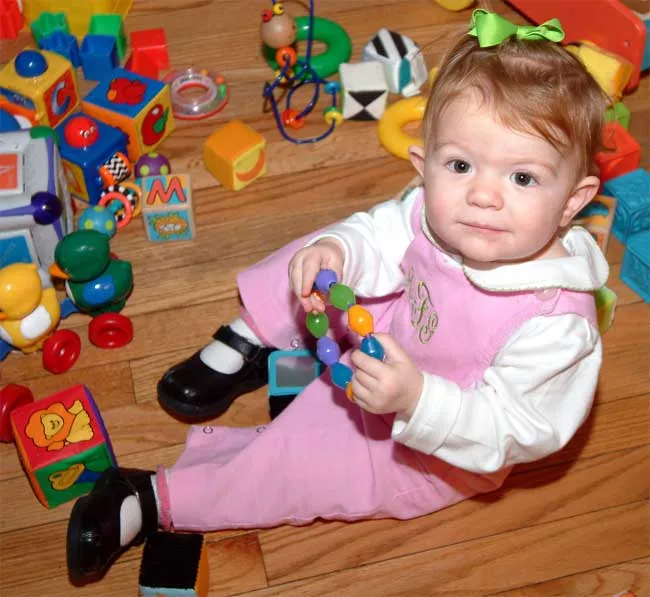
Like adults, babies can remember more things by grouping objects together, a new study found.
The finding shows short term memory in babies works similarly to that in adults, who routinely break information into chunks to remember more of it. The discovery indicates that this memory-boosting trick does not seem to be learned, but may be an innate human ability.
Adults break down phone numbers, social security numbers, and even grocery lists into smaller bits to more easily remember them. Researchers have wondered whether this was a technique we pick up over time, or if it is fundamentally built into our memory system.
So psychologists Lisa Feigenson and Justin Halberda of Johns Hopkins University in Baltimore tested babies to see how their memories work. They found that 14-month-old children could more easily recollect hidden toys and remember greater numbers of toys, if the objects were sorted into groups.
"Our results say you don’t need to be explicitly taught these strategies," Feigenson told LiveScience. "If babies, who don’t have a lot of language ability and haven’t been instructed in the task, can just show they can do this, that tells us this is a very early-developing feature of memory. It tells us that this is something fundamental about the architecture of memory in the brain."
In one experiment, the researchers showed babies four toys, and then hid them in a box, secretly withholding two toys. Then they let the babies look in the box and assumed they would search longer if they remembered that there should be four toys there.
The scientists found that the babies searched longer for the missing toys if the four toys at the beginning consisted of two cats and two cars, and one of each type had been withheld, than if they started with four cats, for example. The researchers concluded that the babies were sorting the familiar items into groups to help remember how many toys they started with.
Get the world’s most fascinating discoveries delivered straight to your inbox.
In another experiment, the researchers showed the babies six identical orange balls, then put them in a box, secretly hiding some. When the scientists spatially separated the balls into three groups of two before hiding them, the babies were able to remember up to six items. This test showed that 14-month-olds can use spatial grouping to boost their short term memory span.
The study indicates that short-term memory capacity and techniques are more similar between babies and adults than scientists once thought.
"One of the questions that philosophers and psychologists have been asking is the nature vs. nurture question — how much does the mind change between infancy and adulthood?" Feigenson said. "On the surface it seems like it changes things a lot, there's an enormous amount of development that occurs. But there are are many aspects that remain totally constant throughout development."
- Video: Attention Training
- Top 10 Mysteries of the Mind
- VIDEO: Baby Mathematician
