













Moles Smell the World from Both Sides

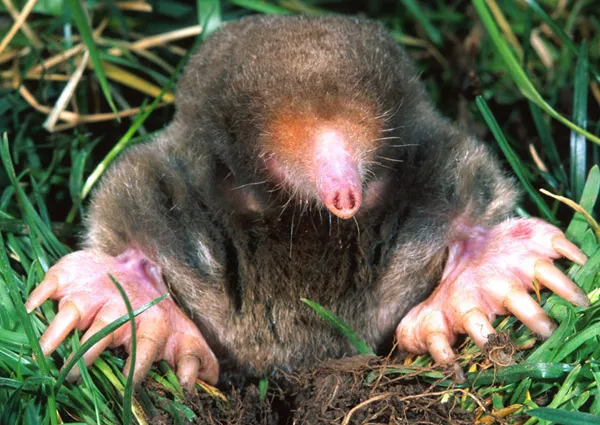
Most mammals can hear in stereo, locating sounds in their environment by comparing the inputs between both ears. Now it appears some mammals use their nostrils the same way for finding smells.
Scientists have long debated whether mammals have stereo scent, the ability to locate a smell based on the strength of odors arriving at each nostril. A new study shows that the common mole (Scalopus aquaticus), found throughout the eastern United States, Canada and Mexico, uses such an ability to sniff out its prey, a researcher reported today (Feb. 5) in the journal Nature Communications.
Neuroscientist Kenneth Catania of Vanderbilt University led the study. Initially, Catania thought the moles' nostrils were too close together to detect odors in different amounts. But his research proved otherwise. "The fact that moles use stereo odor cues to locate food suggests other mammals that rely heavily on their sense of smell, like dogs and pigs, might also have this ability," Catania said in a statement.
Nosey moles
In an experiment, Catania placed a mole in the middle of a semicircular arena with food (bits of earthworm) placed at particular locations around its perimeter. The arena was in a sealed container, and by noting the change in air pressure, Catania was able to detect when the mole sniffed.
The moles found the food morsels in fewer than five seconds and went straight to the correct location every time, Catania said. He noticed that the moles would follow the same pattern: One would enter the chamber, move its nose back and forth while sniffing, hone in on the food, and go directly toward it. [The 10 Weirdest Animal Discoveries]
Next, Catania blocked one of the moles' nostrils with a small plastic tube. When a mole's left nostril was blocked, its path skewed toward the right, and when its right nostril was blocked, its path bent toward the left. The moles were still able to find the food, but it took much longer.
Get the world’s most fascinating discoveries delivered straight to your inbox.
The reach of stereo scent
Then Catania put the moles in a chamber where the food was always directly across from the entrance. Moles with both nostrils unblocked went straight toward the food, but when one nostril was blocked, the moles again veered to the opposite side.
The work strongly resembles a well-known study of barn owls' hearing conducted in 1979 by Eric Knudsen and Mark Konishi of the California Institute of Technology, Catania said. In that study, blocking one of the owls' ears led the animals to misjudge the source of a sound.
In another experiment, Catania put a hollow plastic tube in both of the moles' nostrils and crossed them, so that each nostril sniffed air from the opposite side of the animal. This time, the moles sniffed around and often couldn't find the food at all.
Stereo scent has been found in sharks and other animals before, but whether other mammals possess the ability remains to be seen. Some evidence suggests that stationary rats can be trained to sense flowing air, but no one has studied them behaving naturally (not in the lab). If humans have stereo scent, it appears very weak — humans can only tell which nostril is more strongly stimulated when a smell is strong enough to cause irritation of the nostril lining, studies suggest.
Follow LiveScience on Twitter @livescience. We're also on Facebook & Google+.
