This Research in Action article was provided to LiveScience in partnership with the National Science Foundation.
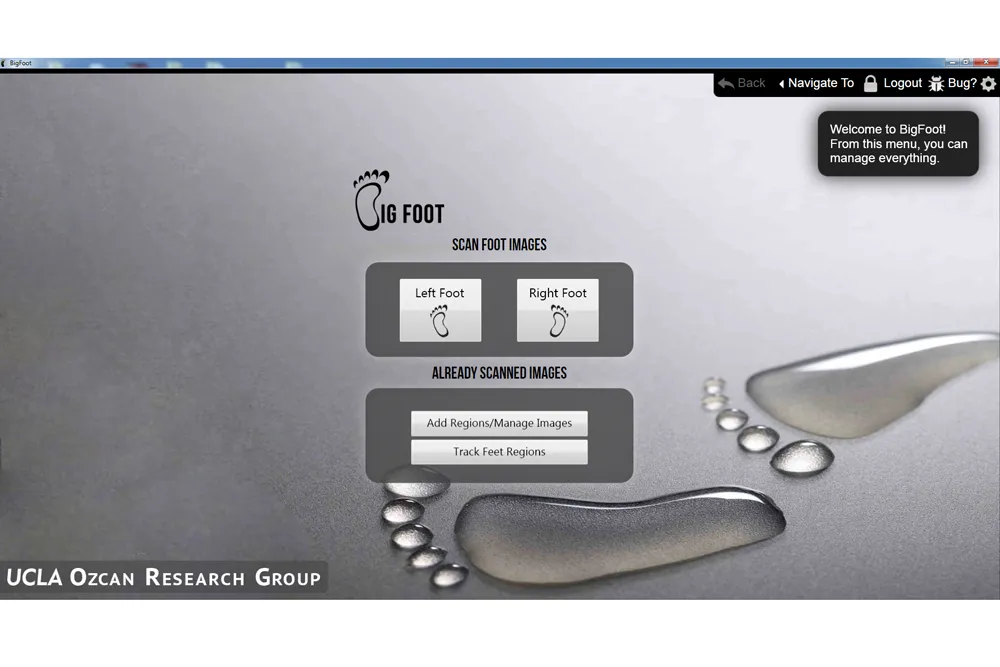
The BigFoot software package, which can be easily downloaded and used by the public and by medical professionals in clinical settings, utilizes a scanner as an image-capture device, with patients placing their feet directly on the scanner's surface. The software's custom-designed set of algorithms then manages and analyzes the acquired foot-image data.
Various medical conditions, including diabetes, can manifest themselves as visible features on the human skin.
Users use scanners to capture the diagnostic image, placing their feet right on the screen.
(Image credit: Aydogan Ozcan.)
Effective monitoring of these superficial features can be of utmost importance as an indirect, and sometimes direct, method of tracking the progression of the underlying medical condition. Diabetes, especially in elderly individuals, can lead to significant visible damage on the surface of the skin, particularly the feet, and may lead to ulcers. Yet patients are not always aware of the extent, or even the existence, of the damage. Many times, they find out about it only through visual inspections during a visit to a doctor's office or point-of-care clinic. However, since such medical visits may not occur frequently enough — something that is especially true in geographical settings where medical resources are limited — significant damage can go undetected and untreated for long periods. Severe cases can necessitate the amputation of the foot.
These issues highlight the need for BigFoot for the monitoring, tracking and sharing of the condition of the feet or other human appendages at home or in point-of-care offices.
Editor's Note: Any opinions, findings, and conclusions or recommendations expressed in this material are those of the author and do not necessarily reflect the views of the National Science Foundation. See the Research in Action archive.
Sign up for the Live Science daily newsletter now
Get the world’s most fascinating discoveries delivered straight to your inbox.