













Christmas Tree's Genes Date to Dinosaur Age

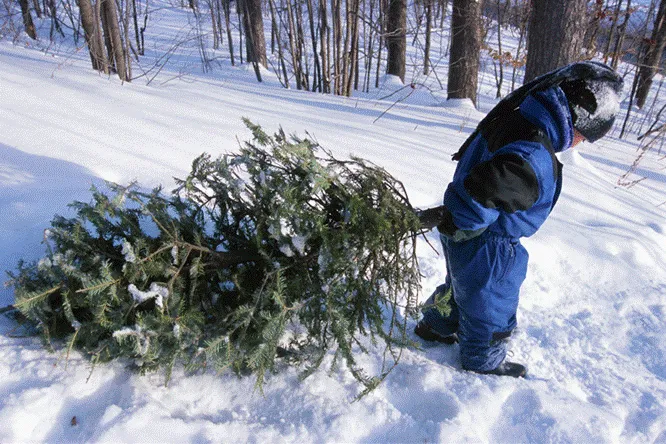
If you were to travel back in time 100 million years to look for your Christmas tree, you would find firs nearly identical to the ones sold today.
New research shows that the genome of conifers — a division that includes spruces, pines and firs — has hardly changed since the days of the dinosaurs.
This stability means there are far fewer species within the taxonomic group today, compared with other types of plants that have splintered off into thousands of different species. Consider, for example, just 600 species of conifers exist today, while more than 400,000 species of flowering plants, or angiosperms, dot the Earth.
"Conifers appear to have achieved a balance with their environment very early," Jean Bousquet, of the Université Laval in Canada, said in a statement. "Still today, without artifice, these plants thrive over much of the globe, particularly in cold climates. In contrast, flowering plants are under intense evolutionary pressure as they battle for survival and reproduction."
Conifers and flowering plants diverged from a common ancestor some 300 million years ago. Bousquet's team compared the genomes of the two plant groups, focusing on 527 spruce genes that fit into 157 gene families; results suggested angiosperms have undergone major changes in the last 100 million years, while conifers have remained particularly unchanged.
"That doesn't mean there haven't been smaller-scale modifications such as genetic mutations," noted Bousquet. "However, the macrostructure of the conifer genome has been remarkably stable over the ages."
A 2005 study detailed in the journal Science found that the conifers' plumbing system might be the secret to their success. The trees carry water up their trunks with tiny, single-celled parallel pipes called "tracheids." These pipes are smaller than those of angiosperms, which would seem to make water flow less efficient in conifers. However, the evergreens have 10 times as many valves (places where the pipes connect) than flowering plants. If conifers hadn't evolved this efficient system, they would have been at a disadvantage in the competition for water.
Get the world’s most fascinating discoveries delivered straight to your inbox.
The new research was published online in October in the journal BMC Biology.
Follow LiveScience on Twitter @livescience. We're also on Facebook & Google+.
