















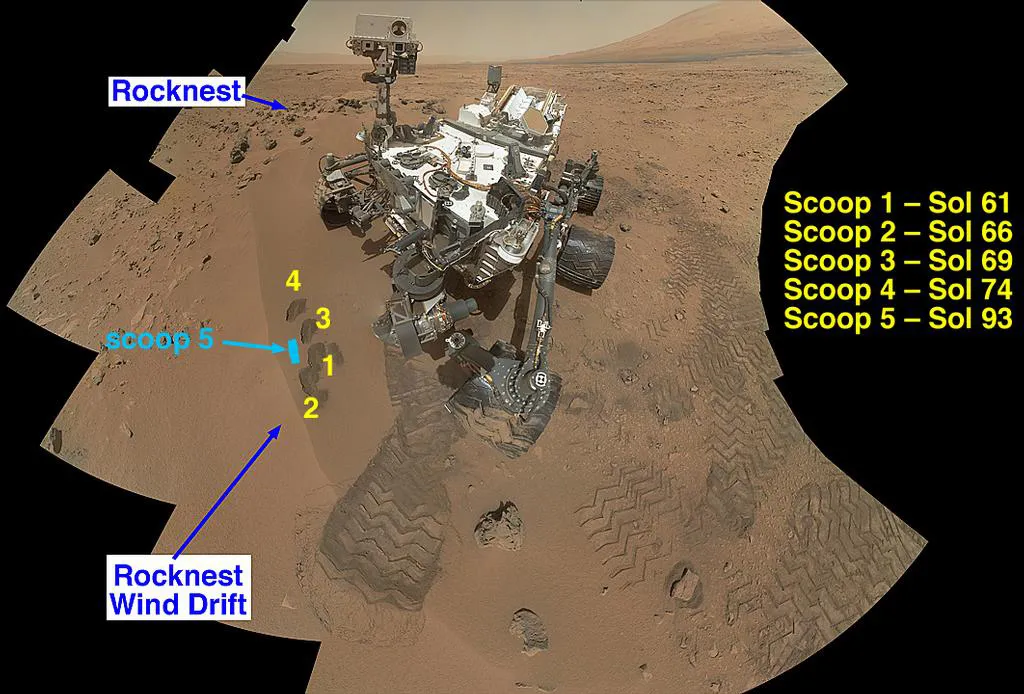
SAN FRANCISCO — Astronauts could endure a long-term, roundtrip Mars mission without receiving a worryingly high radiation dose, new results from NASA's Mars rover Curiosity suggest.
A mission consisting of a 180-day outbound cruise, a 600-day stay on Mars and another 180-day flight back to Earth would expose an astronaut to a total radiation dose of about 1.1 sieverts (units of radiation) if it launched now, according to measurements by Curiosity's Radiation Assessment Detector instrument, or RAD.
That's a pretty manageable number, researchers said.
"The rough ballpark average for an astronaut career limit is on the order of a sievert," RAD principal investigator Don Hassler, of the Southwest Research Institute in Boulder, Colo., said in a presentation here Monday (Dec. 3) at the annual fall meeting of the American Geophysical Union. [Video: Curiosity Takes First Cosmic Ray Sample on Surface]
"NASA has a much more complicated determination for that, but ESA [the European Space Agency], for example, generally uses 1 sievert for that number," he added.
RAD has found radiation levels on the Martian surface to be comparable to those experienced by astronauts in low-Earth orbit. A person ambling around the Red Planet would receive an average dose of about 0.7 millisieverts per day, while astronauts aboard the International Space Station experience an average daily dose between 0.4 and 1.0 millisieverts, Hassler said.
RAD's measurements show that Mars' atmosphere — though just 1 percent as thick as that of Earth — provides a significant amount of protection from the fast-moving particles streaking through our galaxy. (Mars lacks a global magnetic field, which helps shield Earth further.)
Get the world’s most fascinating discoveries delivered straight to your inbox.
The long deep-space journey to Mars is another matter. RAD was turned on for most of Curiosity's eight-month cruise to the Red Planet, and its data show that any potential Mars explorers would likely get around 1.9 millisieverts per day during the flight.
"We can survive the Mars surface. The hard part is the cruise," Hassler said.
RAD's data are far from the full story of radiation on (or en route to) Mars, Hassler stressed. For example, solar storms can blast huge clouds of charged particles into space, affecting radiation levels significantly. Curiosity flew through a few such clouds during its cruise but has yet to experience one on the Red Planet surface.
Potential radiation doses will also change as solar activity waxes and wanes on its regular cycle. Galactic cosmic rays vary by a factor of two over the course of the sun's 11-year activity cycle, Hassler said.
The $2.5 billion Curiosity rover launched from Florida's Cape Canaveral Air Force Station on Nov. 26, 2011, and landed inside Mars' huge Gale Crater on the night of Aug. 5, 2012. The rover is embarked on a two-year prime mission to determine if Mars can, or ever could, support microbical life.
This story was provided by SPACE.com, a sister site to Live Science. Follow SPACE.com senior writer Mike Wall on Twitter @michaeldwall or SPACE.com @Spacedotcom. We're also on Facebook and Google+.
