














Curiosity Rover Snaps Stunning Self-Portrait on Red Planet

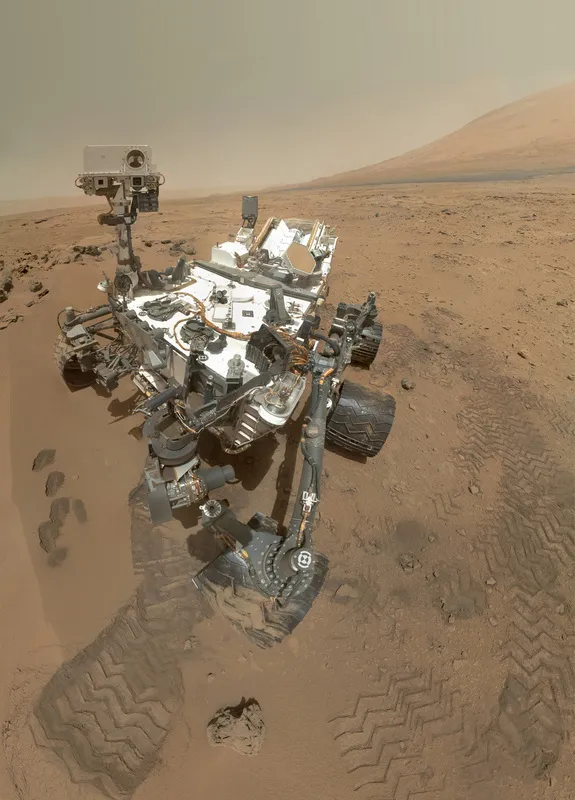
Like a tourist who snaps a photo of himself in front of the Eiffel Tower, NASA's Mars rover Curiosity has stretched out its arm and captured a high-resolution self-portrait in spectacular surroundings.
The 1-ton Curiosity rover took 55 hi-res pictures with its Mars Hand Lens Imager camera, or MAHLI, on Oct. 31. Mission scientists then stitched the images together to create a full-color mosaic of Curiosity and its Gale Crater landing site.
Curiosity touched down inside Gale on Aug. 5, kicking off a two-year mission to determine if Mars could ever have supported microbial life.
The new composite image shows the six-wheeled robot at a spot called "Rocknest," where Curiosity has been testing out its scooping and soil-sampling systems for the first time. Four scoop marks are visible in the Martian dirt in front of the rover.
At the right of the frame rises Mount Sharp, the mysterious 3-mile-high (5 kilometers) mountain at Gale Crater's center. Mount Sharp's foothills are Curiosity's main science destination, for they show signs of long-ago exposure to liquid water.
The mountains in the background to the left are the northern wall of Gale Crater, researchers said.
Self-portraits like this one have more than just gee-whiz appeal for the Curiosity team. The image helps engineers assess the health of the $2.5 billion rover and track changes over time, such as wheel wear and dust accumulation, researchers said.
Get the world’s most fascinating discoveries delivered straight to your inbox.
Curiosity bears 17 cameras along with 10 science instruments, but MAHLI is the only tool that can image certain parts of the rover, such as its port-side wheels. That's because MAHLI sits at the end of Curiosity's five-jointed, 7-foot-long (2.1 meters) robotic arm.
Curiosity's arm also sports a drill capable of boring an inch (2.5 centimeters) deep into rock. The mission team hopes to test out this drill at or around Rocknest. After that activity is completed, the rover should start heading toward the base of Mount Sharp — perhaps by the end of the year or so, scientists have said.
This story was provided by SPACE.com, a sister site to Live Science. Follow SPACE.com on Twitter @Spacedotcom. We're also on Facebook & Google+.
