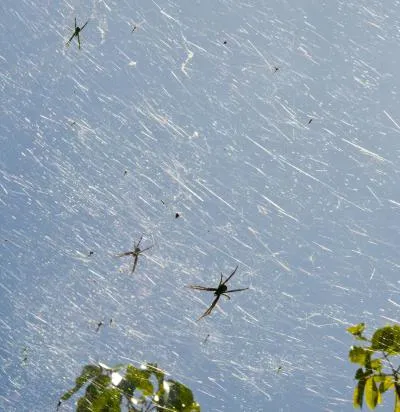
Ecologists have found as many as 40 times more spiders in Guam's remote jungle than are found on nearby islands. In some places, a dense fabric of webs fills gaps between trees in the jungle canopy.
The jungles of Guam have up to 40 times more spiders than do the forested areas of nearby Pacific islands thanks in part to the brown tree snake, according to a study published this week in the journal PLoS One.
The bird-devouring snake from northern Australia and nearby islands was introduced to Guam in the 1940s. The ravenous reptile became the dominant predator; bird numbers plummeted. By the 1980s, 10 of 12 native bird species had been wiped out, and the last two survive only in small areas, protected by intense snake-trapping.
Small-scale experiments show that areas without birds have more spiders – which makes sense, because birds eat spiders and the insects upon which spiders feed. But the sheer numbers of spiders found in Guam's jungles were much greater than predicted by these small studies, suggesting the removal of birds from an entire forest can have unforeseen — and creepy — effects.
Study author Haldre Rogers, a researcher at Rice University in Houston, counted spiders throughout Guam's jungles by counting spider webs (which correlate with spider population and are commonly used as a stand-in measurement).
The difference between the number of spiders Rogers and her colleagues counted on Guam and three nearby islands that still have birds "was far more dramatic than what any small-scale experiments had previously found," she said in a statement from Rice.
The highly invasive brown tree snake wiped out native forest birds on the island of Guam.
(Image credit: Isaac Chellman)
"Anytime you have a reduction in insectivorous birds, the system will probably respond with an increase in spiders," Rogers said. And she thinks this may be true elsewhere. "With insectivorous birds in decline in many places in the world, I suspect there has been a concurrent increase in spiders."
Guam spends $1 million per year searching departing planes and cargo for stowaway snakes. But the nocturnal reptile is hard to find, especially on the island itself; residents and tourists rarely see them, and even those who actively hunt the snakes often come up empty-handed, according to the release.
Sign up for the Live Science daily newsletter now
Get the world’s most fascinating discoveries delivered straight to your inbox.
For the science geek in everyone, Live Science offers a fascinating window into the natural and technological world, delivering comprehensive and compelling news and analysis on everything from dinosaur discoveries, archaeological finds and amazing animals to health, innovation and wearable technology. We aim to empower and inspire our readers with the tools needed to understand the world and appreciate its everyday awe.