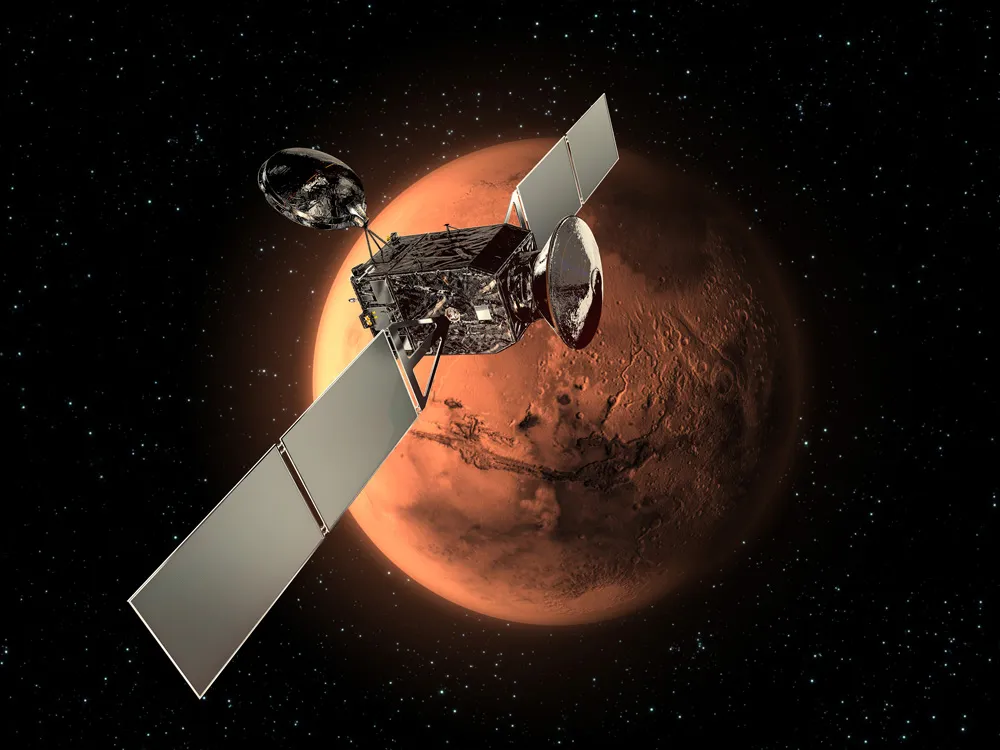
The ExoMars Trace Gas Orbiter, along with an Entry, Descent and Landing Demonstrator Module (EDM), form the first mission in the European-led ExoMars program. The Orbiter and EDM are scheduled to arrive at Mars in 2016. This image shows the Orbiter and the EDM in cruise configuration.
Though 2012 has been a rough year for international cooperation in planetary exploration, space agencies around the globe should remain committed to working together, a prominent researcher says.
In February, budget cuts forced NASA to bow out of the European-led ExoMars mission, which aims to launch an orbiter and a rover to the Red Planet in 2016 and 2018, respectively. But that bad experience shouldn't sour the European Space Agency or its international counterparts on collaborating, says David Southwood, who was director of science and robotic exploration at ESA from 2001 to 2011.
"In the end, the economic advantages of international cooperation manifestly outweigh the increased risks," Southwood writes in a commentary in tomorrow's (Aug. 23) issue of the journal Nature.
To give such collaborations the best chance of succeeding, scientists and administrators should take lessons from what happened with ExoMars and other failed partnerships, he adds. [Gallery: The ExoMars Mission]
"Learning from what has gone wrong in the past is vital if these consortia are to be successful," writes Southwood, now a researcher at Imperial College London, president of the Royal Astronomical Society and a steering-board member of the United Kingdom Space Agency.
Southwood's comments come a few weeks after NASA landed its $2.5 billion Curiosity rover on Mars, and just days after the space agency announced that it will launch a mission called InSight in 2016 to study the Red Planet's interior. Both projects have significant international contributions in their science instruments.
The ExoMars saga
Sign up for the Live Science daily newsletter now
Get the world’s most fascinating discoveries delivered straight to your inbox.
Southwood examines ExoMars as a sort of case study of what can go wrong when space agencies decide to pool their resources and their expertise.
The mission was born in 2005 as a European enterprise, though it was scheduled to blast off aboard a Russian Soyuz rocket. But ExoMars grew in scope and complexity, spurring ESA to seek out new partners. NASA officially came aboard in 2009.
The mission's architecture changed to accommodate the goals of both ESA and NASA, Southwood writes, and to help build toward a Mars sample-return effort in the future — a key priority of NASA and the U.S. National Academy of Sciences, as laid out in the Academy's Planetary Science Decadal Survey in 2011.
By October 2009, the mission design included launching an ESA lander in 2016 and two rovers — one each from ESA and NASA — two years later.
But in April 2011, NASA canceled its rover. And then in February of this year, reeling from a 20 percent cut to its planetary science program, the U.S. space agency pulled out of ExoMars altogether.
"For me, my old colleagues in ESA, and many people in the European science community, I think it was traumatic," Southwood told SPACE.com via email, referring to NASA's withdrawal. [NASA's 2013 Budget: What Will It Buy?]
He thinks the incident may have long-lasting effects on collaboration between the two space agencies.
"Most European scientists have good collegial relationships with US scientists, and that won't change," Southwood said. "Rather, and this is a key part of my message, it is a managerial issue; the risk analysis has changed. US standing as AAA partner of choice is now downgraded."
Russia has agreed to step in as ESA's main partner on ExoMars, filling the gap left by the United States.
Moving forward
A concept image for the ExoMars rover that is being developed for a 2018 mission to Mars.
(Image credit: ESA)
Southwood identifies five lessons that can be learned from ExoMars and other collaborations that didn't go as planned (such as the International Solar Polar Mission, which was renamed Ulysses and taken over by ESA after budget cuts compelled NASA to cancel its spacecraft contribution to the project in 1981).
First, he says, each partner must understand the others' motivations. Second, partners should be prepared to drop features of a mission if costs threaten to spiral out of control. Lesson three is closely related to this last point: Design the mission in a modular way, so the project can continue if parts of it fail or must be jettisoned.
Fourth, Southwood says, keep in mind that international agreements are not ironclad. They can be broken, even if billions of dollars are at stake.
"It seemed unthinkable that NASA would drop a Mars sample-return mission deemed as a first priority in the decadal review, but it happened," Southwood writes.
The fifth and final lesson Southwood draws: If an international mission is threatened, make a strong political case for the benefits of collaboration. Politicians may not be swayed by purely scientific arguments, but they may back a project if they see other virtues in it.
"In my opinion, cooperation goes beyond simple economics — it breaks down cultural differences, builds mutual trust, opens up scientific potential worldwide and conveys inspiration globally, and thereby benefits all humanity," Southwood writes. "The damage done by breaking understandings, however technically legal, is to be avoided for all these reasons."
Michael was a science writer for the Idaho National Laboratory and has been an intern at Wired.com, The Salinas Californian newspaper, and the SLAC National Accelerator Laboratory. He has also worked as a herpetologist and wildlife biologist. He has a Ph.D. in evolutionary biology from the University of Sydney, Australia, a bachelor's degree from the University of Arizona, and a graduate certificate in science writing from the University of California, Santa Cruz.