Maars are not your typical volcanoes.
These explosive geological oddities don't form neat, cone-shaped mountains. Rather, they can crop up just about anywhere within certain volcanically active areas. Maars are created when a rising plume of magma interacts with underground water, creating a mixture that bursts out of the ground without much warning.
To get a better idea of where and when these eruptions might strike, Greg Valentine, a researcher at SUNY Buffalo, is trying to recreate his own miniature maars.
Latest Videos FromLive Science
A better understanding of this phenomenon could lead to better warnings before explosions, and could also help geologists locate hidden sources of diamonds, which can form in maars, Valentine said.
The problem is, there are very little data on maar eruptions, which happen worldwide about once every 20 years, he said. They are also short-lived; after forming, they are active for a few weeks to a few years before disappearing.
Mimicking maars
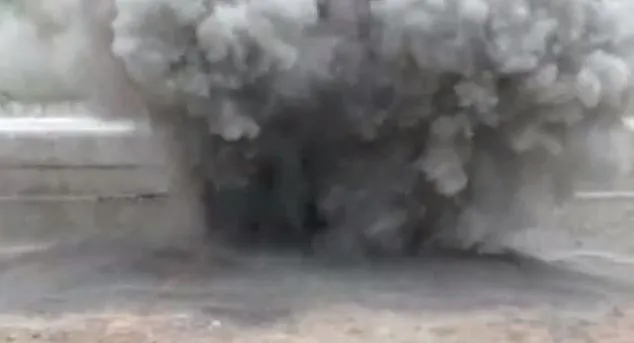
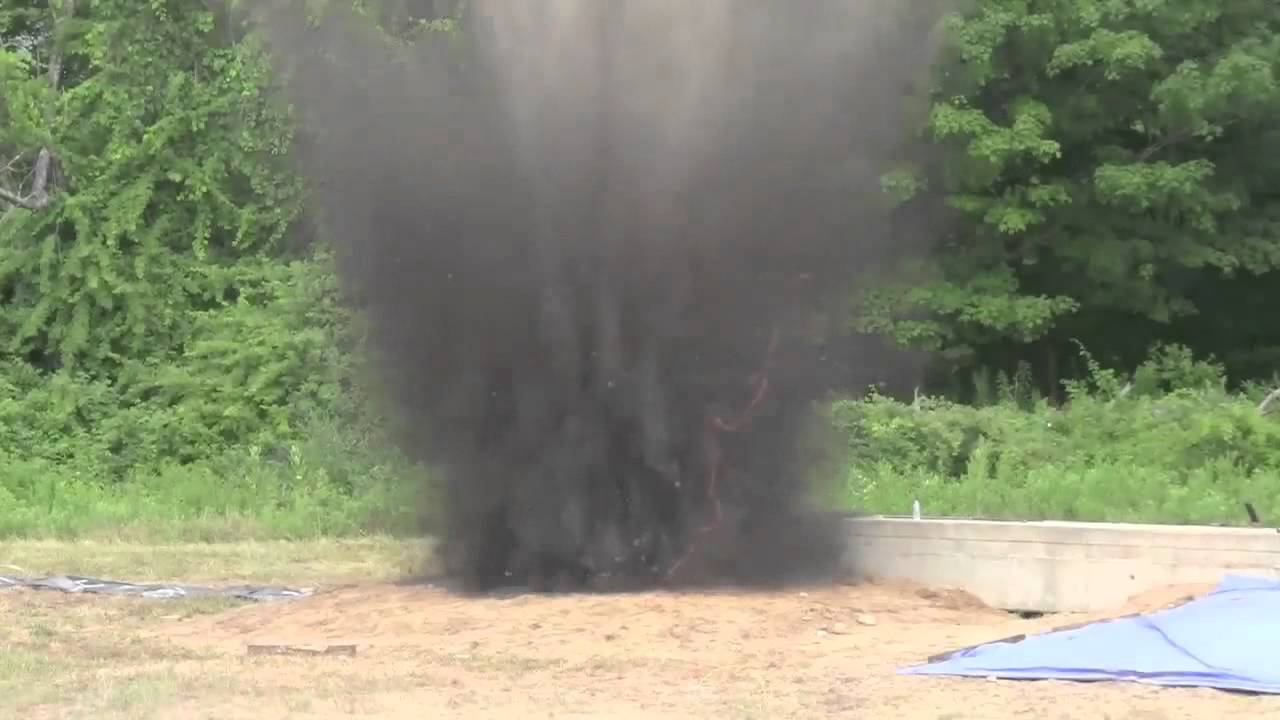
Valentine recently performed a series of experiments in which he did his best to mimic a maar: he buried explosives, filmed their detonation and carefully sifted through the resulting craters, he told OurAmazingPlanet.
He found that the width of the explosion crater was not directly linked to the size of the explosion. For example, a crater with a small width did not necessarily mean the explosion was small.
"From a hazards perspective, we want to know about the energy of the individual explosions," Valentine said. That's because it's the energy measure most relevant to how much damage to a blast is likely to inflict on nearby buildings or people.
For example, one high-energy explosion is more dangerous than, say, three separate explosions collectively as powerful, he said. Larger explosions are more likely to launch large rocks and create bigger shock waves.
However, the shape of a crater does give some information about the nature of a maar's blast.
In one experiment, Valentine buried one pound of explosives, mostly TNT. After it blew, it left behind a coned-shaped crater. In another experiment he detonated three explosives in the same spot, one after another, each one-third of a pound. The result was a bowl-shaped hole, he said. But both had roughly the same width.
"You can't use the diameter of a crater produced by multiple explosions to estimate energy of individual explosions," he said. "But you can use the shape of the crater. We went back to these pads and carefully excavated them, similar to what an archaeologist would do." His results have yet to be published in a journal, he said.
Diamonds in the maar
Maar eruptions create structures beneath the Earth's surface called diatremes, which are an important source of diamonds around the world. That's because maars are occasionally formed by a specific type of molten rock known as kimberlite, in which diamonds form. Learning more about how diatremes form could help locate diamonds, Valentine said.
Valentine is planning more complex experiments, including using a mixture of magma and water, rather than explosives, to better simulate a maar.
Although maars aren't extremely common, their unpredictable nature could make them quite destructive. Just like stratovolcanoes such as Mount St. Helen's, maars can form pyroclastic flows of superheated gas and rock, or throw up clouds of fine-grained ash that could affect air traffic, like Iceland's Eyjafjallajökull volcano.
Recent maars have occurred in relatively unpopulated areas, such as Alaska. But they have the potential to form and wreak havoc in several well-populated regions, including Japan, Mexico City and Flagstaff, Ariz.
Reach Douglas Main at [email protected]. Follow him on Twitter @Douglas_Main. Follow OurAmazingPlanet on Twitter @OAPlanet. We're also on Facebook and Google+.