













Meet the Mickey Mouse of Mongolia
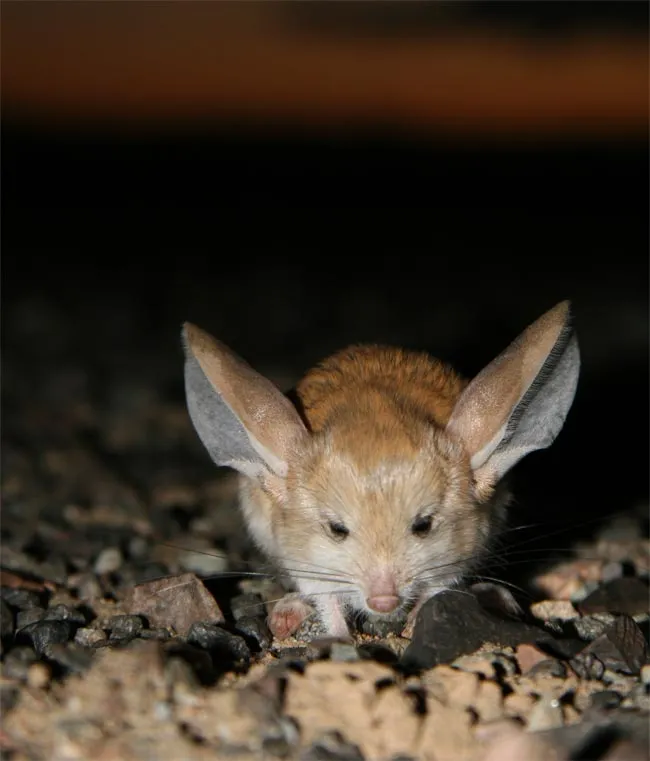
Dubbed the "Mickey Mouse of Mongolia," the long-eared jerboa took a star turn recently when it was caught on camera for the first time in the wild.
But that might be one of the rodent's last roles, if habitat disturbances and other threats continue, pushing the long-eared jerboa over the edge. The species is classified as "endangered" by the World Conservation Union.
The terrestrial rodent, Euchoreutes naso, was filmed in the Mongolian Gobi desert by scientists from the Zoological Society of London. Weighing in at about an ounce (up to 38 grams), with huge, whimsical ears and lengthy hind legs made for hopping, the tea-cup sized creature did not disappoint as it bounded around in the darkness.
The researchers say the footage will have implications for protecting the globally endangered animal, about which little is known. For instance, scientists don't know how many individuals exist in the wild or whether this jerboa behaves like its relatives in the family Dipodidae, such as birch mice and other jerboas.
Jerboas are considered nocturnal, spending daylight hours catching shut-eye in underground tunnels.
The long-eared jerboa can be distinguished from other jerboas by its enormous ears, which are about a third larger than its head. And rather than sporting a coat of sandy fur like most jerboas, the long-eared species is covered with reddish-yellow fur with white underparts. While most jerboas munch on seeds and plant material, scientists think the long-eared jerboa eats mostly insects.
The expedition was part of ZSL's EDGE program, which focuses on evolutionarily distinct and endangered species. Results from video footage and the program's field research will help scientists design a conservation plan for the long-eared jerboa.
Get the world’s most fascinating discoveries delivered straight to your inbox.
- Video: 'Mickey Mouse' Rodent Hops into Film
- Top 10 Species Success Stories
- Image Gallery: Creatures of the Wild
Jeanna Bryner is managing editor of Scientific American. Previously she was editor in chief of Live Science and, prior to that, an editor at Scholastic's Science World magazine. Bryner has an English degree from Salisbury University, a master's degree in biogeochemistry and environmental sciences from the University of Maryland and a graduate science journalism degree from New York University. She has worked as a biologist in Florida, where she monitored wetlands and did field surveys for endangered species, including the gorgeous Florida Scrub Jay. She also received an ocean sciences journalism fellowship from the Woods Hole Oceanographic Institution. She is a firm believer that science is for everyone and that just about everything can be viewed through the lens of science.