Freedom of expression is a broader term than freedom of speech. It comprises freedom of speech, of the press, of association, of assembly and petition – all of protected by the First Amendment. The relevant portion of the First Amendment of the United States Constitution, written in 1791 reads: “Congress shall make no law respecting an establishment of religion, or prohibiting the free exercise thereof; or abridging the freedom of speech, or of the press; or the right of the people peaceably to assemble, and to petition the government for a redress of grievances.”
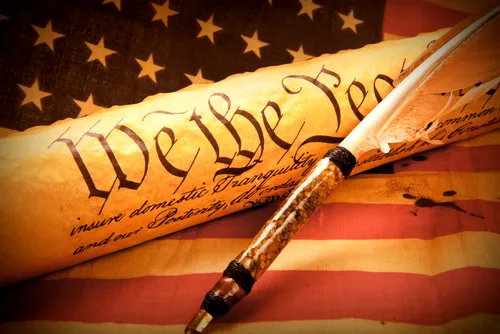
The U.S. Constitution guarantees the inalienable rights of citizens.
The Supreme Court has written that the right to freedom of expression is "the matrix, the indispensable condition of nearly every other form of freedom." Without it, other fundamental rights, like the right to vote, would wither and die. The Court has recognized that some forms of artistic expression are protected under the First Amendment, including: painting, music, poetry, motion pictures, dramatic works, radio and television entertainment, drawings, and engravings.
However, some forms of expression are more protected than others, an issue the Supreme Court has grappled with over the years. As with the limitations to the freedom of speech, things that are out of bounds for protection as freedom of expression include defamation, causing panic, fighting words, incitement to crime, sedition, and obscenity.
The right to freedom of expression is also related to the right to a fair trial and court proceeding, which may limit access to information or determine the opportunity and means in which freedom of expression is manifested within court proceedings. In general, freedom of expression may not limit the right to privacy, as well as the honor and reputation of others – but greater latitude is given when criticism of public figures is involved. The right to freedom of expression is particularly important for media, which plays a special role as the bearer of the general right to freedom of expression for all. However, freedom of the press is not necessarily enabling freedom of speech.
Freedom of expression has old roots – in Greek and Roman societies such freedoms existed alongside robust democracies. In the American colonies where rights were often curtailed by the English government, it was Jefferson who ultimately persuaded James Madison to propose the Bill of Rights, and the First Amendment was Jefferson's top priority.
Related:
Sign up for the Live Science daily newsletter now
Get the world’s most fascinating discoveries delivered straight to your inbox.