













Ancient Animal Treasures Found in Bahamas Sinkhole

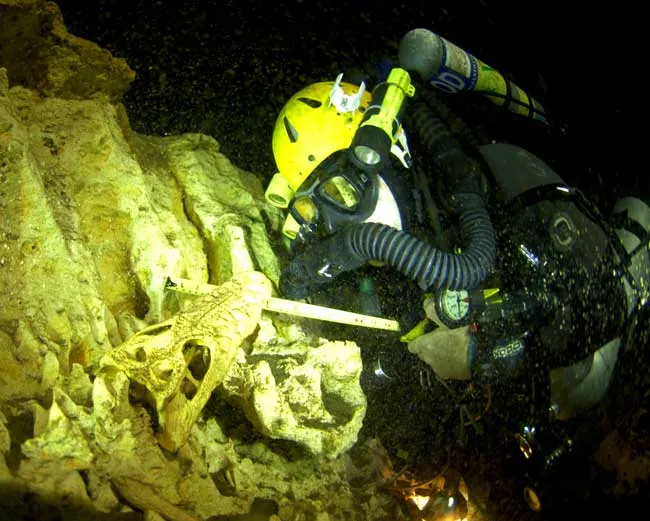
Fossil skeletons of an unusual land-roaming Cuban crocodile, a tortoise and 25 species of birds including a raptor known as a caracara are among the ancient treasures recently discovered in a sinkhole in the Bahamas. Expert diver Brian Kakuk and his colleagues retrieved these fossils, along with the bones of a lizard, snakes, humans and bats, along the floor and walls of Sawmill Sink, a saltwater cavern of a type called a blue hole on Abaco Island. The bones, ranging in age from 1,000 to 4,200 years old, were very well preserved in the deep, oxygen-free saltwater layer of the sinkhole, which is free of the bacteria and fungi that typically munch on bones. Divers also found fossilized leaves, twigs, flowers, fruits, seeds, pollen and spores. David Steadman, a University of Florida ornithologist, said the fossils allowed him to reconstruct the ancient plant and animal communities of the Bahamas, as well as the impact that humans had when they first arrived there, which he detailed in the latest issue of the journal Proceedings of the National Academy of Sciences. For instance, the terrestrial crocodile lived in the Bahamas until humans arrived, Steadman said. "People tend to think of crocodiles as aquatic, and certainly most of them are," he said, "but in the Bahamas where there is no fresh water, the crocodile became a terrestrial predator." The local climate and environmental conditions back when these animals lived were much like those of today. "The big difference is us," Steadman said. "When people got to the island, there was probably nothing easier to hunt than tortoises, so they cooked and ate them. And they got rid of crocodiles, because it's tough to have kids playing at the edge of the village where there are terrestrial crocodiles running around." There are many blue holes on Abaco and other Bahamian islands, but this is the first to be the site of a sophisticated fossil excavation, Steadman said.
- Dino Quiz: Test Your Smarts
- Snakes, Frogs and Lizards: The Best of Your Images
- Top 10 Secret Weapons of Animals
Get the world’s most fascinating discoveries delivered straight to your inbox.
