













American Obesity Rate Continues to Rise (Infographic)

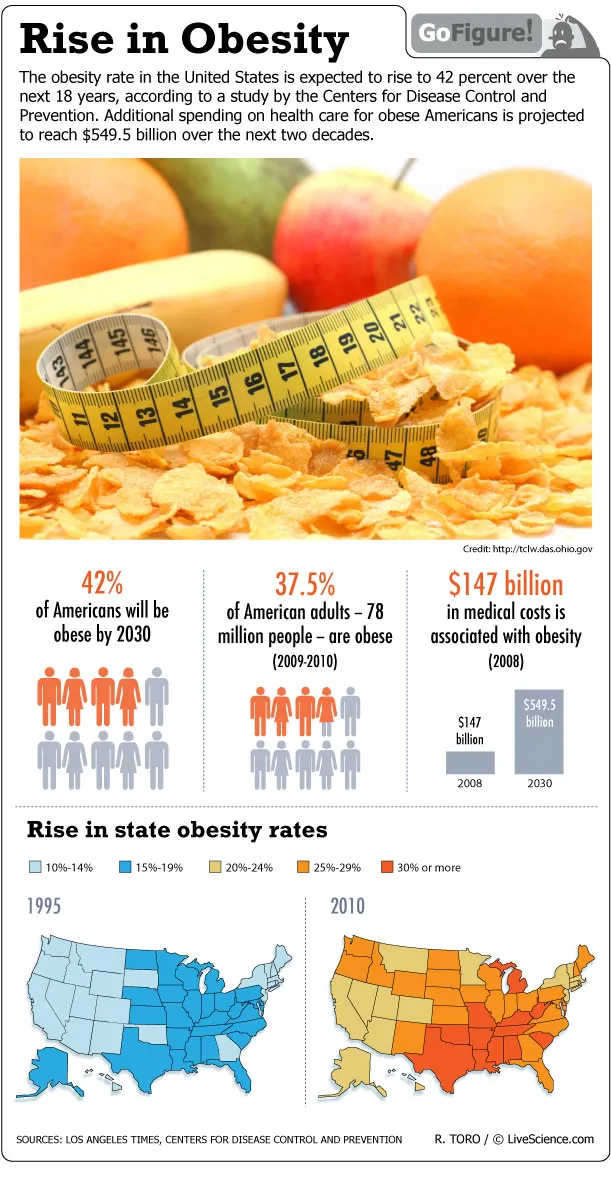
By 2030, 42 percent of Americans may be obese; that's an additional 32 million people expected to be obese within the next two decades, new research from Duke University suggests.
The study, detailed May 7 in the American Journal of Preventive Medicine, also forecasts an increase in the number of individuals with severe obesity, which is defined as a body mass index (BMI) over 40, or roughly 100 pounds (45 kilograms) overweight. They expect rates of severely obese individuals to rise 11 percent by 2030. BMI is a relatively accurate way to measure body fatness in most people, with the Centers for Disease Control and Prevention (CDC), grouping people in this manner:
| Below 18.5 | Underweight |
| 18.5 – 24.9 | Normal |
| 25.0 – 29.9 | Overweight |
| 30.0 and Above | Obese |
Severely obese individuals are at highest risk for the health conditions linked to the excess weight, resulting in substantially greater medical expenditures and rates of absenteeism.
"Should these forecasts prove accurate, the adverse health and cost consequences of obesity are likely to continue to escalate without a significant intervention," said study researcher Justin Trogdon of RTI International, an independent nonprofit research institution.
They calculated what could be saved, then, if obesity rates were kept the same instead of rising.
"Keeping obesity rates level could yield a savings of nearly $550 billion in medical expenditures over the next two decades," said lead author Eric Finkelstein, associate research professor in the Duke Global Health Institute.
The results were also released May 7 at the Centers for Disease Control and Prevention's Weight of the Nation conference in Washington, D.C.
Get the world’s most fascinating discoveries delivered straight to your inbox.
