














New 'Bumblebee' Gecko Species Creates Buzz

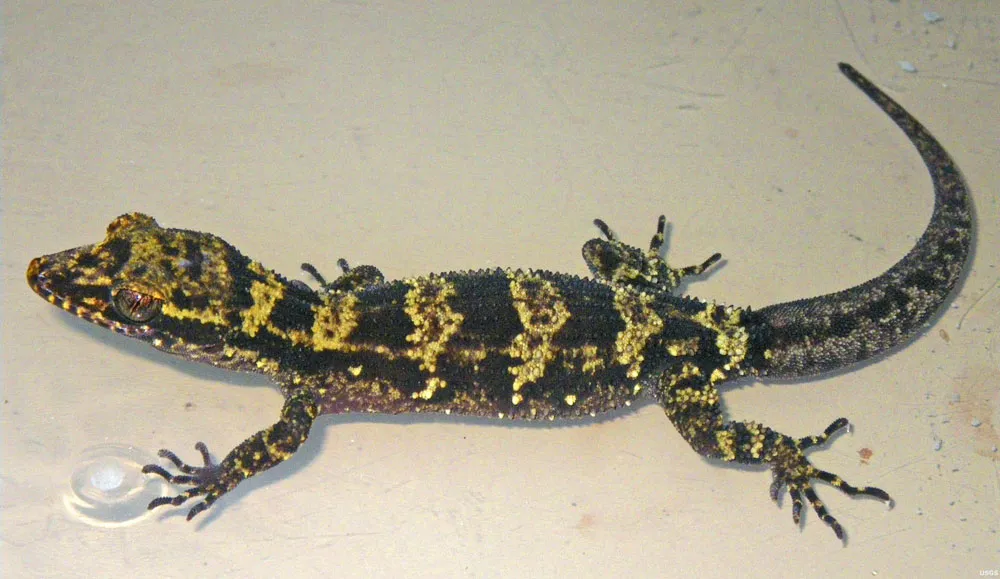
A new species of gecko with bumblebeelike black and yellow stripes has been discovered in Papua New Guinea.
Herpetologist Robert Fisher of the USGS Western Ecological Research Center found two bumblebee geckos in Sohoniliu Village on Manus Island in May 2010.
The lizard measures about 5 inches (12.7 centimeters) from head to tail, and in addition to its stripes, it sports rows of skin nodules, adaptations that enhance its camouflage on the tropical forest floor.
"We've officially named it Nactus kunan for its striking color pattern — kunan means 'bumblebee' in the local Nali language," Fisher said in a statement. "It belongs to a genus of slender-toed geckos, which means these guys don’t have the padded, wall-climbing toes like the common house gecko, or the day gecko in the car insurance commercials."
Fisher and George Zug of the Smithsonian Institution analyzed the genetics of the lizard to show that it was indeed a new species and have described it in the current issue of the journal Zootaxa.
"This species was a striking surprise, as I've been working on the genus since the 1970s, and would not have predicted this discovery," said Zug, a curator emeritus at the National Museum of Natural History.
Two more species were found on the trip and await further analysis.
Get the world’s most fascinating discoveries delivered straight to your inbox.
"Exploration of Manus Province is in its infancy, with many new species possible, and this joint expedition was our first to this region," said Bulisa Iova, the reptile curator at the Papua New Guinea National Museum.
The research was supported by the Smithsonian, U.S. Department of Defense and USGS.
This story was provided by OurAmazingPlanet, a sister site to LiveScience.
