













Secrets of Molecule that Helped Build the Universe Exposed

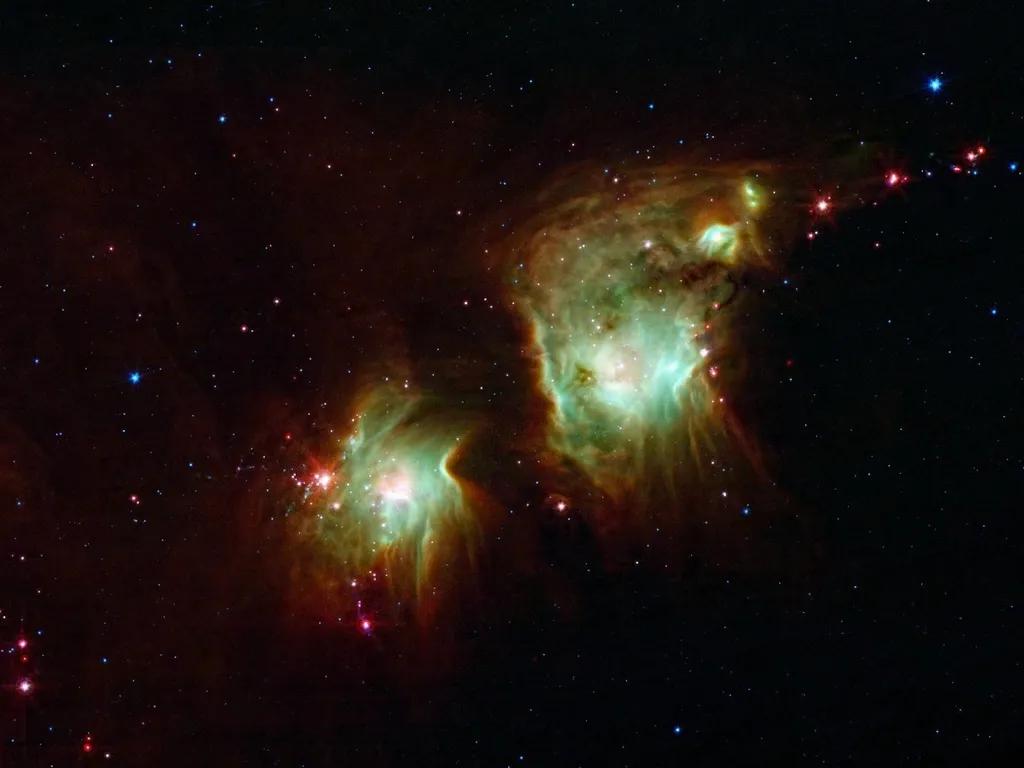
A new study of one of the most fundamental molecules in the universe has given scientists clues into how the very first stars were formed.
For the first time, researchers have calculated the vibration patterns of a compound called H3+ (also known as a triatomic hydrogen ion), which consists of three hydrogen atoms sharing two electrons. Knowing how the molecule can vibrate allows scientists to predict which wavelengths of lightit will emit, giving them a way to identify its signature in astronomical observations.
H3+ is important because it is thought to have been prevalent in the universe just after the Big Bang that started things off around 13.7 billion years ago.
"Most of the universe consists of hydrogen in various forms," University of Arizona chemist Ludwik Adamowicz said in a statement, "but the H3+ ion is the most prevalent molecular ion in interstellar space. It's also one of the most important molecules in existence."[Wacky Physics: The Coolest Little Particles in Nature]
H3+'s vibration and light-emitting qualities may have enabled it to transfer heat away from the first stars as they were in the process of forming, allowing them to coalesce without overheating and bursting apart.
"There wouldn't be any star formation if there weren't molecules that slowly cool down the forming star by emitting light," said Michele Pavanello, who was a University of Arizona graduate student when he worked on the project. "Astronomers think that the only molecule that could cool down a forming star in that particular time is H3+."
Adamowicz and Pavanello used a computer simulation to model the behavior of H3+, based on quantum mechanics.
Get the world’s most fascinating discoveries delivered straight to your inbox.
"One has to involve a large amount of computations at the quantum mechanical level to predict those vibrations," Adamowicz said. "The role of theory is essentially to simulate those vibrations in the computer and then describe how the molecule is swinging or dancing."
Their simulations predicted numerous potential vibrations that would cause H3+ to emit photons of specific wavelengths, or energies. If telescope observations of a particular cloud in space reveal light of these wavelengths, then astronomers will know the cloud contains H3+.
The calculations should also help scientists understand the complicated physics of how stars form, especially the earliest stars in the universe.
"The only way we can predict how the stars form is if we know very well what the cooling abilities of H3+ are, and we cannot know its cooling ability until we know its vibrational spectrum," Pavanello said. "We need to know what these energy levels are. With this paper, we have pinpointed the energy levels up to a certain energy threshold that is already good enough to generate accurate predictions of the cooling ability of H3+."
The results of the study were reported in a recent issue of the journal Physical Review Letters.
Follow LiveScience for the latest in science news and discoveries on Twitter @livescience and on Facebook.
