













Carbon Dioxide Linked to End of Last Ice Age

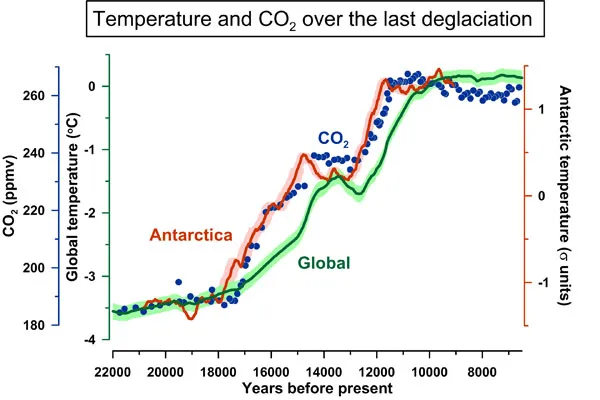
The circumstances that ended the last ice age, somewhere between 19,000 and 10,000 years ago, have been unclear. In particular, scientists aren't sure how carbon dioxide, a greenhouse gas, played into the giant melt.
New research indicates it did in fact help drive this prehistoric episode of global warming, even though it did not kick it off. A change in the Earth's orbit likely started of the melt, setting off a chain of events, according to the researchers.
The ambiguity about the end of the ice age originates in the Antarctic. Ice cores from the continent reveal a problematic time lag: Temperatures appeared to begin warming before atmospheric carbon dioxide increased. This has led scientists to question how increasing carbon dioxide — a frequently cited cause for global warming now and in the distant past — factored into the end of the last ice age. Global warming skeptics have also cited this as evidence carbon dioxide produced by humans is not responsible for modern global warming.
But the data from Antarctica alone offer too narrow a perspective to represent what was happening on a global scale, according to lead study researcher Jeremy Shakun of Harvard University.
"These ice cores only tell you about the temperatures in Antarctica where they are from, and if you think about today the same way, you don't want to look at one thermometer record from London or New York to prove or disprove global warming," Shakun said during a press conference on Tuesday (April 3).
Shakun and colleagues compiled 80 proxy records of prehistoric temperature for that time around the world. These included chemical clues like the ratio of oxygen isotopes (atoms of different weights) in ice cores, the amount of magnesium incorporated into the shells of tiny organisms that settled on the ancient seafloor, as well as pollen that indicates what plants were living at the time.
Carbon dioxide levels were recorded by tiny bubbles of ancient atmosphere within the ice, Shakun said.
Get the world’s most fascinating discoveries delivered straight to your inbox.
Using these they found evidence that global warming lagged behind warming in Antarctica and the increase in atmospheric carbon dioxide. So why did Antarctica warm up early?
Shakun and colleagues offer a sort of chain reaction to explain.
Around 20,000 years ago, normal cycles in the Earth's orbit, which varies slightly over tens of thousands or a 100,000 years, brought more sunlight to the northern hemisphere. This caused ice in the Northern Hemisphere to melt. The freshwater flooded into the Atlantic Ocean weakening an ocean circulation pattern that brought cold water to the south. As a result, Antarctica warmed.
After this was underway, about 17,500 year ago, carbon dioxide levels rose. It's not clear where the carbon dioxide came from; it's possible the melting of ice over the Southern Ocean made it possible for carbon stored in the water to escape into the air or that changes in winds brought it to the surface, according to Shakun.
The additional carbon dioxide in the atmosphere further warmed the planet and led to more melting, and ultimately, the end of the ice age, according to him.
The research appeared in Thursday's (April 5) issue of the journal Nature.
Eric Wolff of the British Antarctic Survey, writing in a commentary in the same issue, calls the reconstruction of prehistoric global temperatures "a major accomplishment." But Wolff writes that the proposal that warming in the north acted as a trigger should be taken with caution because of a shortage of data showing warming for the high latitudes and because the increase in sunlight the north received was relatively minor.
You can follow LiveScience writer Wynne Parry on Twitter @Wynne_Parry. Follow LiveScience for the latest in science news and discoveries on Twitter @livescience and on Facebook.
