













Our Galaxy's Giant Black Hole May Munch on Asteroids

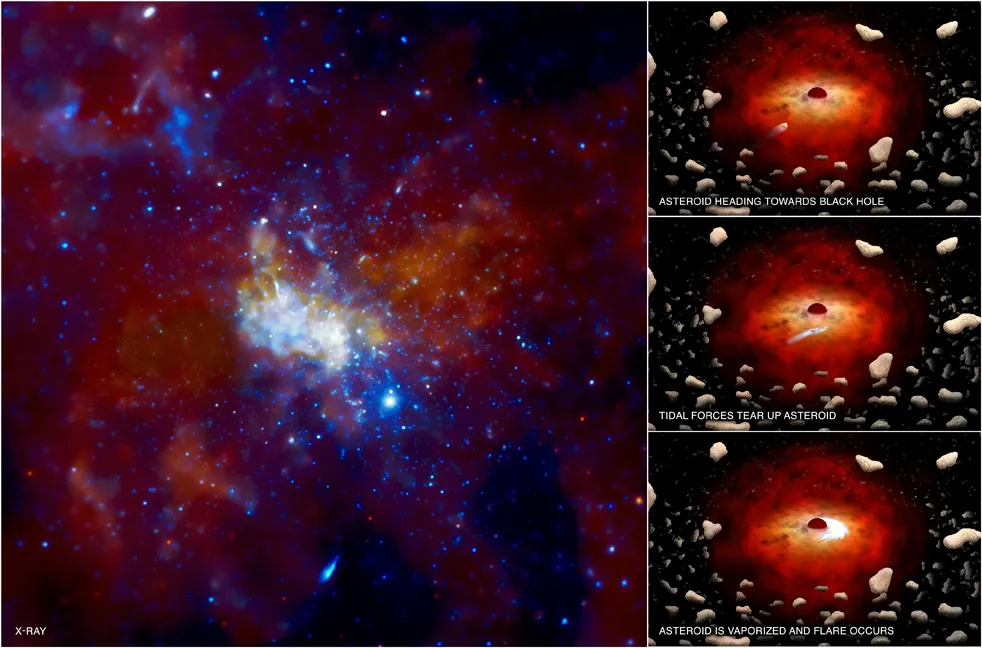
The gigantic black hole at the heart of our Milky Way galaxy may be devouring asteroids on a daily basis, a new study suggests.
For several years, NASA's Chandra spacecraft has detected X-ray flares about once a day coming from our galaxy's central black hole, which is known as Sagittarius A* (Sgr A* for short). These flares may be caused by asteroids falling into the supermassive black hole's maw, according to the study.
"People have had doubts about whether asteroids could form at all in the harsh environment near a supermassive black hole," study lead author Kastytis Zubovas, of the University of Leicester in the United Kingdom, said in a statement. "It's exciting because our study suggests that a huge number of them are needed to produce these flares."
Asteroids circling a black hole
Zubovas and his colleagues suggest that a cloud around Sgr A* contains trillions of asteroids and comets that the black hole stripped from their parent stars.
Asteroids passing within about 100 million miles (160 million kilometers) of the black hole — roughly the distance between the Earth and the sun — are likely torn to pieces by Sgr A*'s gravity, according to the study. [Photos: Black Holes of the Universe]
These fragments would be vaporized by friction as they encounter the hot gas flowing onto the black hole, much as meteors are burned up by the gases in Earth's atmosphere. This vaporization likely spawns the X-ray flares, which last for a few hours and range in brightness from a few times to nearly 100 times that of the black hole's regular output, researchers said.
Get the world’s most fascinating discoveries delivered straight to your inbox.
Sgr A* then swallows up what's left of the close-flying asteroid.
"An asteroid's orbit can change if it ventures too close to a star or planet near Sgr A*," said co-author Sergei Nayakshin, also of the University of Leicester. "If it's thrown toward the black hole, it's doomed."
It would take an asteroid at least 6 miles (10 km) wide to generate the flares seen by Chandra, the researchers estimate. The black hole may also be consuming smaller space rocks, but the resulting flares would likely be too faint to observe.
Trillions of asteroids
The new study is in rough agreement with previous modeling work, which has estimated that trillions of asteroids are likely to surround the Milky Way's central black hole.
"As a reality check, we worked out that a few trillion asteroids should have been removed by the black hole over the 10-billion-year lifetime of the galaxy," said co-author Sera Markoff of the University of Amsterdam in the Netherlands. "Only a small fraction of the total would have been consumed, so the supply of asteroids would hardly be depleted."
Sgr A* is probably also devouring planets that stray too close, causing much more powerful X-ray flares than those analyzed in the new study. Such dramatic events are likely rare, since planets are not nearly as common as asteroids, researchers said.
However, scientists may have observed the aftermath of the Milky Way's black hole gobbling up a planet. About 100 years ago, the X-ray output of Sgr A* brightened by a factor of a million. While this event happened before the existence of X-ray telescopes, Chandra and other instruments have seen evidence of an X-ray "echo" reflecting off nearby clouds, researchers said.
The researchers report their results in the Monthly Notices of the Royal Astronomical Society.
This article was provided by SPACE.com, a sister site to LiveScience. Follow SPACE.com for the latest in space science and exploration news on Twitter @Spacedotcom and on Facebook.
