













Explorers Trek from North to South Pole

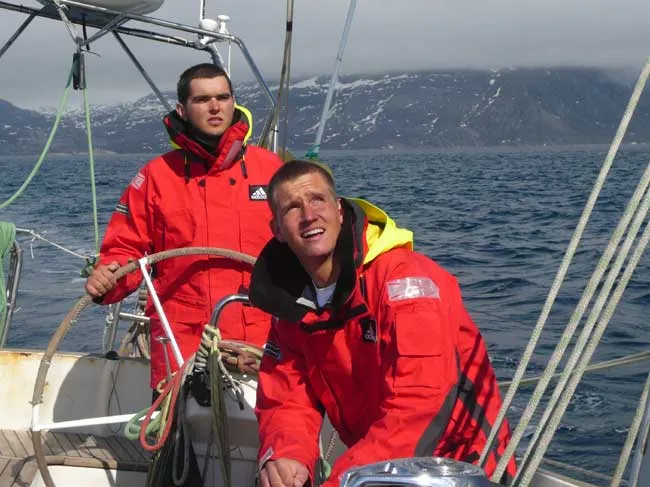
By sled, ski and sail, two explorers are making a year-long trek between Earth’s two poles to highlight the impact of climate change.
Rob Gauntlett and James Hooper, two 20-year-olds from England, have undertaken the more than 22,000-mile journey from one end of the Earth to the other using only methods of transportation that don't emit pollution. They plan to travel by sled, ski, sailboat, bicycle and foot for the duration of the 180-degree pole-to-pole challenge.
The two adventurers dreamed up the journey after scaling to the summit of Mount Everest last year. While researching and planning this new, much longer trip, they realized it was an opportunity to show people the impacts of climate change first-hand and to educate the public about how to change habits to have less impact on the environment.
"We wanted to do something which no one had done before," Gauntlett said.
While speaking to hunters in Greenland, Gauntlett and Hooper learned of the impacts that ice melt has had on the Inuits' survival, shortening the hunting season and making it harder for communities to support and feed themselves.
"They've noticed a huge, huge change in the rate of ice melt," Gauntlett said. "There isn’t enough ice to support them."
While skiing across thinning Arctic ice, Gauntlett fell through and spent a week in the hospital recovering.
Get the world’s most fascinating discoveries delivered straight to your inbox.
"I'm kind of living proof that it is happening," Gauntlett told LiveScience.
The pair set off from the geomagnetic North Pole (located just off the northwest coast of Greenland) on April 8, skiing across 500 miles of sea ice, and is slated to arrive at the Magnetic South Pole (just off the coast of the Antarctic continent) at the beginning of February 2008. As of Monday morning, Gauntlett and Hooper were en route to Austin, Texas, on their way across the United States headed toward Mexico.
The two explorers have felt the opposite extreme of Earth's climate while cycling through the Southeast, which is in the grips of a record-breaking heat wave. By cycling across the land, the two explorers hope to encourage people to cycle to work instead of driving.
Gauntlett and Hooper began cycling after arriving in New York City in July, where they made a stop at the Live Earth concert, a worldwide event promoted by former Vice President Al Gore to raise global warming awareness. The cycling leg will take them 5,000 miles from New York to Panama, where they will sail to Guayaquil, Ecuador.
The main points in their itinerary include:
- Started at Geomagnetic North Pole – April 8
- Gauntlett fell through ice – May 26
- Arrival in New York – July 3
- Live Earth appearance – July 7
- Set to arrive in Panama – Sept. 16
- Planned arrival in Guayaquil – Sept. 22
- Planned arrival via bicycle into Punta Arenas, Chile – Dec. 26
- Set sail for Magnetic South Pole – Dec. 31
- Expected arrival at Magnetic South Pole – beginning of February 2008
You can follow the explorers' journey at their website: www.180degrees.com.
- North vs. South Poles: 10 Wild Differences
- Top 10 Surprising Results of Global Warming
- Timeline: The Frightening Future of Earth

Andrea Thompson is an associate editor at Scientific American, where she covers sustainability, energy and the environment. Prior to that, she was a senior writer covering climate science at Climate Central and a reporter and editor at Live Science, where she primarily covered Earth science and the environment. She holds a graduate degree in science health and environmental reporting from New York University, as well as a bachelor of science and and masters of science in atmospheric chemistry from the Georgia Institute of Technology.