













Americans' Beliefs in Paranormal Phenomena (Infographic)

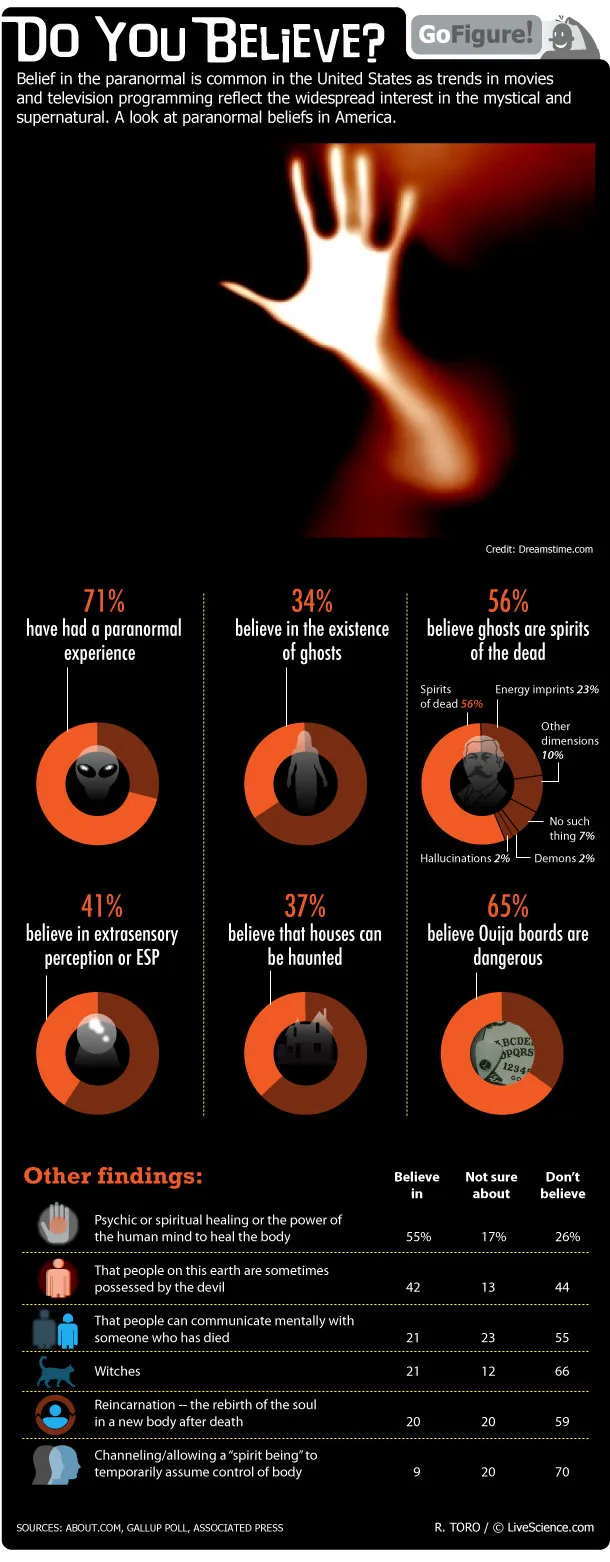
So why do people believe in the paranormal?
Experiences perceived as paranormal are not uncommon, according to Richard Wiseman, a University of Hertfordshire psychologist and author of "Paranormality," (Macmillion, 2011), which delves into the science (or lack thereof) of hauntings, psychics, telepathy and other supposedly inexplicable phenomena.
The thrust of the book was to figure out why people have these weird experiences despite spirits and psychics and ghosts not existing, he said.
"There's also the notion that these beliefs are very comforting. So if you're ill, then the idea of the psychic healer is a nice idea," Wiseman told LiveScience in July. "And then there's the influence of the paranormal industry. The books, the television shows, the psychic hotlines all have a vested interest in getting the public to believe this stuff." [Read: Monsters, Ghosts & Gods: Why We Believe]
These beliefs can tell us a lot about human nature and psychology, it seems. For instance, reports of ghosts may be fueled more than anything else by the power of suggestion along with some fear. Say you're in a haunted house and you see something out of the corner of your eye; the "haunted" location could lend itself to one perceiving the odd glimpse as paranormal. Then there's fear: "When we become afraid, blood flows from the fingertips from the major muscles of the body as you get ready to run or fight, and that can make you cold," Wiseman said in July. "You also become hyper-vigilant, so you start noticing footsteps or voices you wouldn’t have noticed before, and start assuming this is some sort of weird paranormal activity." [Read: What's Really Behind Paranormal Experiences - Hint: It's Not Ghosts]
As for who believes, a small study published in the Skeptical Inquirer magazine in 2006 showed that seniors and grad students were more likely than freshmen to believe in haunted houses, psychics, telepathy, channeling and a host of other questionable ideas. So higher education seems to lend itself to belief in the supernatural. In additon, Gallup Poll in 2001 found younger Americans far more likely to believe in the paranormal than older respondents. A 2009 Pew Research Center survey revealed that about half of Catholics and black Protestants believed in or had experienced at least two of a list of supernatural phenomenon. The list included: belief in reincarnation, belief in spiritual energy located in physical things, belief in yoga as spiritual practice, belief in the "evil eye," belief in astrology, having been in touch with the dead, consulting a psychic, or experiencing a ghostly encounter.
Even if such ghosts and goblins aren't real, they can sure scare us. So if you're home alone and hear an seemingly unexplainable creaking noise or see a glimpse of a "ghost," Wiseman suggests knowledge is your best weapon against a freak out. "I think that just knowing what's going on helps," he said. Take a Ouji Board: Once you realize the glass is moved by one's unconscious movements, the resulting letters are less scary, albeit less meaningful possibly.
Get the world’s most fascinating discoveries delivered straight to your inbox.
- Top 10 Unexplained Phenomena
- 13 Halloween Superstitions & Traditions Explained
- Halloween's Top 10 Scary Creatures
