













New Twin Tower Collapse Model Could Squash 9/11 Conspiracies

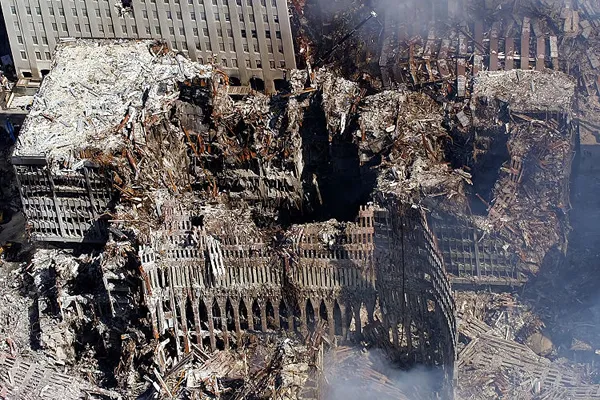
Many 9/11 conspiracy theories revolve around explosions that were seen and heard in the World Trade Center's Twin Towers prior to their collapse. Despite scientific investigations that have explained the processes that brought down the skyscrapers, some conspiracy theorists suggest the plane impacts were just red herrings, to distract from the fact that 9/11 was an "inside job" — that explosives had been implanted earlier in the World Trade Center buildings and were what really brought them down.
Now a materials scientist has come up with a more scientific explanation for the mystery booms, and says his model of the Twin Towers collapse leaves no room for conspiracies. "My model explains all the observed features on 11th September: the explosions, molten metal coming out of the window, the time passing between the crash and the collapse, the fact that the explosions took place in a floor below the place it was burning, and the rapid collapse," Christen Simensen of SINTEF, a research organization in Norway, told Life's Little Mysteries.
As detailed in the new issue of Aluminum International Today, Simensen argues that molten aluminum from the airplane bodies chemically reacted with water in the buildings' sprinkler systems, setting off the explosions that felled the Twin Towers. [Did Nostradamus Really Predict the 9/11 Terrorist Attacks?]
Chain of events
When each jet cut its way into a building, it took with it parts of walls and ceilings, Simensen said. Steel bars in those walls would have gashed its fuel tanks, which would have caught fire. With the plane positioned somewhere in the middle of the building, blanketed in debris and with no route for heat to escape, the temperature would have rapidly escalated, reaching 660 degrees Celsius (1,220 degrees Fahrenheit), the melting point of aluminum — of which there was 30 tons in each plane fuselage — within an hour. The molten aluminum would then have heated up further to between 800 and 850 C (1,470 and 1,560 F).
"Then molten aluminum becomes [as liquid as] water and has so much heat that it will flow through cracks in the floor and down to the next floor," Simensen explained in an email. There was an automatic sprinkler system installed in each ceiling, and it was filled with water. "When huge amount of molten aluminum gets in contact with water, a fierce exothermic reaction will take place, enormous amount of hydrogen is formed and the temperature is locally raised to 1,200 to 1,500 C," or 2,200 to 2,700 F.
Chaos rapidly ensues: "A series of explosions will take place and a whole floor will be blown to pieces," he wrote. "Then the top part of the building will fall on the bottom part, and the tower will collapse within seconds." This is what Simensen believes happened in the two World Trade Center towers.
Get the world’s most fascinating discoveries delivered straight to your inbox.
This isn't obscure chemistry, Simensen says; the U.S. Aluminum Association has recorded 250 accidental molten aluminum/water explosions worldwide since 1980. "Alcoa in Pittsburgh [the worldwide leader in aluminum production] has done a series of such explosions in special laboratory in order to understand what can prevent such explosions and what are the most dangerous situations," he wrote. "For instance they let 30 kilograms [66 pounds] of aluminum react with 20 liters [5.3 gallons] of water, which resulted in a large hole 30 meters [98 feet] in diameter, and nothing left of the laboratory."
The third tower
A third building, World Trade Center 7, fell eight hours after the others. Scientists explained that this happened because of fires that ignited in the building upon the collapse of WTC 1, but some conspiracy theorists take it as further proof that the impacts of the hijacked airplanes weren't what brought any of the buildings down.
Simensen says his theory does not challenge the accepted scientific explanation of the collapse of WTC7.
"The official governmental report said the collapse [of World Trade Center 1 and 2] was due to overheating steel bars in the buildings and did not mention anything about explosions. Their theory … can be used to explain why WTC7 … collapsed. This collapse took place after eight hours of fire and was much slower than the collapse of WTC 1 and WTC 2," Simensen wrote. [10 Ways 9/11 Impacted Science]
Fiery reaction
Simensen's new collapse model has not gained immediate acceptance by proponents of earlier models.
"Occam's Razor says that the simplest explanation is usually the best," said Thomas Eagar, a materials scientist at MIT who has also studied the fall of the towers. "I do not see any merit to this new, more-complex explanation. Any firefighter trying to extinguish a fire without having the water or the electricity shut off will tell you that there will be periodic explosions from inside the building. I don't need to invoke some water/molten aluminum theory to explain this."
Eagar also objects to the notion that the aluminum, if it did melt, would definitely have reacted with the water it encountered. Most of the time when water is sprayed on molten aluminum, "there is no explosion because the water turns to steam and excludes the oxygen, preventing the growth of the combustion," he said.
Along similar lines, Zdenek Bazant, a professor of mechanical engineering at Northwestern University who was first to model how fires could have caused steel columns in the towers to buckle (leading to the buildings' collapses), thinks that the official explanation suffices. "I've explained it in six papers in leading journals," Bazant said. In his opinion, all factors related to the collapse have been accounted for.
But not everyone in the industry agrees with the simpler, official explanation. Roughly 1,600 architects and structural engineers across the country, who have banded together in a group called "Architects and Engineers for 9/11 Truth," say it does not fully account for the buildings' collapses. With so many people looking for answers, Simensen's alternative theory is likely to receive further attention and study.
This article was provided by Life's Little Mysteries, a sister site to LiveScience. Follow us on Twitter @llmysteries, then join us on Facebook. Follow Natalie Wolchover on Twitter @nattyover.

Natalie Wolchover was a staff writer for Live Science from 2010 to 2012 and is currently a senior physics writer and editor for Quanta Magazine. She holds a bachelor's degree in physics from Tufts University and has studied physics at the University of California, Berkeley. Along with the staff of Quanta, Wolchover won the 2022 Pulitzer Prize for explanatory writing for her work on the building of the James Webb Space Telescope. Her work has also appeared in the The Best American Science and Nature Writing and The Best Writing on Mathematics, Nature, The New Yorker and Popular Science. She was the 2016 winner of the Evert Clark/Seth Payne Award, an annual prize for young science journalists, as well as the winner of the 2017 Science Communication Award for the American Institute of Physics.