














Can We Make Jurassic Park Yet?

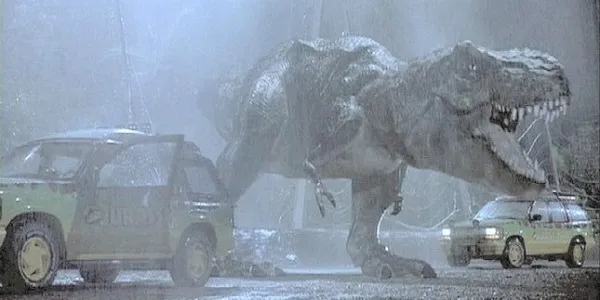
Find an ancient mosquito trapped in amber. Draw dinosaur blood from its belly. Extract DNA from that blood and insert it into a crocodile embryo. Hatch the egg. Feed the dino. Start an amusement park. Don't open the gates.
That series of steps might have sounded pretty fanciful back in 1993 when the blockbuster film "Jurassic Park" (based on the book by Michael Crichton) hit theaters. Today though, in the world of genome sequencing, transgenic (hybrid) animals, and bacteria built from scratch in the lab, the resurrection of extinct species sounds a little more feasible. Is it?
Turns out scientists might very well create dinosaurs or dinosaur-like creatures in the not-so-distant future. They won't do it in the way Crichton envisioned, though.
Unfortunately, DNA molecules, the genetic instructions for creating life, break down over time. Sixty-five million years have passed since dinosaurs last flew, swam and walked the Earth, and DNA seldom stays intact longer than 500,000 years. According to Jack Horner, a renowned dinosaur paleontologist at Montana State University and the technical adviser for all the Jurassic Park films, we've never actually found dino DNA. He and his colleagues discovered soft tissue from a Tyrannosaurus rex in 2005, but even that contained no usable material: "The soft tissue is apparently composed of biomolecules other than DNA," Horner told Life's Little Mysteries, a sister site to LiveScience.
Even if we do someday find ancient dinosaur DNA, it will be in shambles — snippets of code just a few base pairs long. We'll have no idea how to stitch the snippets together. Thus, sequencing the dinosaur genome from fossilized tissues or blood may never be a viable route to their revival.
Jurassic chicken
But geneticists are trailblazing an alternative path to Jurassic Park. In the past few years, several groups working independently have begun to awaken the dormant dinosaur DNA present in one of the extinct creatures' descendents: chickens, whose genome is fully sequenced. Led by Horner, the scientists hope to eventually grow a chicken that has teeth, scales, a tail, and forelimbs. In a word, they want to build a "dinochicken," and it'll be pretty darn close to the real thing. [The Surprising Connection Between T. Rex and Turkeys]
Feed your curiosity with an exclusive mystery every week, solved with science and delivered direct to your inbox before it's seen anywhere else.
First, in 2005, developmental biologists John Fallon and Matt Harris at the University of Wisconsin were experimenting with mutant chicken embryos when they noticed strange protuberances emerging from the chicken fetus's jaws. The bumps turned out to be saber-shaped teeth identical to those of embryonic alligators.
The toothy chicken embryos were mutants — they possessed a recessive gene that kills fetuses before they're born. As a side effect (unrelated to how it killed them), that gene was switching on another one that has lain dormant in chickens' evolutionary line for at least 70 million years: an ancient dinosaur tooth gene. Fallon and Harris created a virus that behaved similarly to the lethal recessive gene present in the mutant chickens, but without being deadly. When they inserted the virus into normal chicken embryos, they grew teeth.
Later, a paleontologist named Hans Larsson at McGill University found that chicken embryos' start out with tails. At a certain point in a chick's development, a genetic switch flips and the tail goes away. Using growth hormones to try to override the stoppage, Larsson and his colleagues are attempting to flip the switch back (though they haven't done so yet).
In the same vein, Horner believes chicken embryos can eventually be genetically manipulated to develop forearms instead of wings. "The absence of a tail, the difference between wings and grasping forearms, and the absence of teeth are all subtle evolutionary changes on a basic dinosaur plan," he wrote in a book he co-authored with James Gorman called "How to Build a Dinosaur" (Dutton 2009).
So how long will it be before the scientists create a dinochicken? "It may be a few years as it mostly depends on funding," Horner said. In a world where cancer remains uncured, not everyone thinks dinosaur revivalism deserves a share of the meager monetary offerings available for scientific research. Others — perhaps, someday, a wealthy private investor — think it would be cool.
This article was provided by Life's Little Mysteries, a sister site to LiveScience. Follow Life's Little Mysteries on Twitter @llmysteries, then join us on Facebook. Follow Natalie Wolchover on Twitter @nattyover.

Natalie Wolchover was a staff writer for Live Science from 2010 to 2012 and is currently a senior physics writer and editor for Quanta Magazine. She holds a bachelor's degree in physics from Tufts University and has studied physics at the University of California, Berkeley. Along with the staff of Quanta, Wolchover won the 2022 Pulitzer Prize for explanatory writing for her work on the building of the James Webb Space Telescope. Her work has also appeared in the The Best American Science and Nature Writing and The Best Writing on Mathematics, Nature, The New Yorker and Popular Science. She was the 2016 winner of the Evert Clark/Seth Payne Award, an annual prize for young science journalists, as well as the winner of the 2017 Science Communication Award for the American Institute of Physics.