
 Live Science Plus


Strange Coral: A Gallery of Sea Pens

Dinner Time
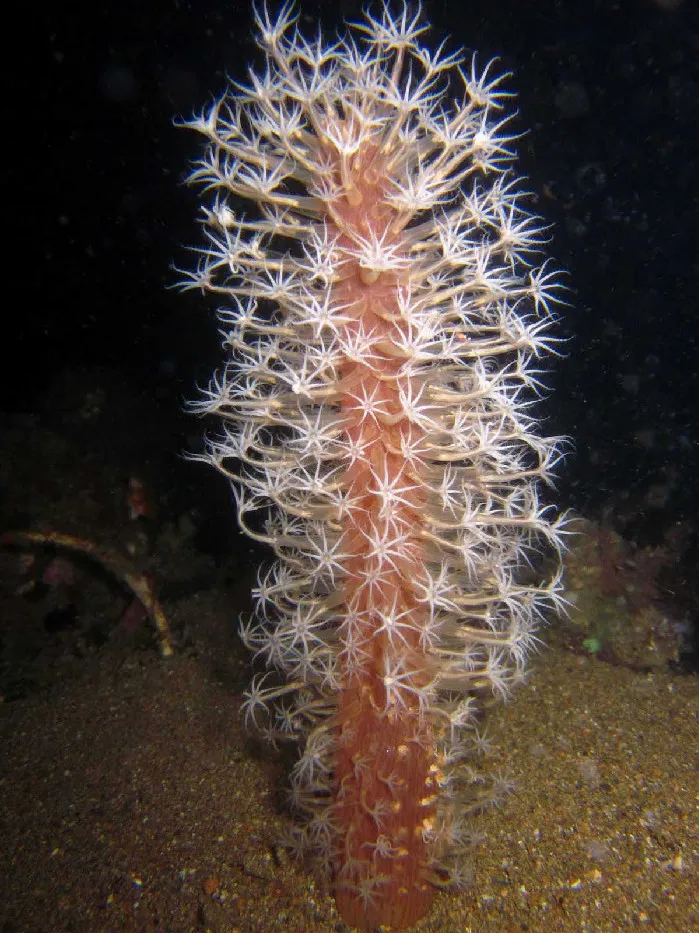
A nocturnal Veretillum sea pen gathers dinner with its flower-like polyps unfurled as it feeds using the eight tentacles surrounding each polyp's mouth.
A Sea Pen Out of Water

A sea pen that belongs to the genus Pteroeides after it was collected from 60 feet (18.3 meters) of water near Maricaban Island, Philippines. The yellow and orange section of its stalk is called a peduncle. It anchors the sea pen to the ocean floor. The dark, leaf-like structures contain the polyps, each with a mouth surrounded by tentacles. An individual sea pen can also be considered a colony of polyps.
On the Sea Floor

Although it looks much different, this is the same animal shown in the previous picture, before being plucked from its watery home near Maricaban Island, Philippines and taken to the surface.

Night Life for Sea Pens

Another species of Pteroeides, this time at night, near Calumpan Peninsula, Luzon, Philippines. Some sea pens prefer the night life, hiding under the sand or sediment during the day and emerging, with branches of mouths and tentacles searching for tiny morsels of plankton for dinner.
Boney Branches

Sea pens, a type of coral, have hard, internal skeletons, visible in this Pteroeides as thin white ribs in its branches. In addition to long skeletal elements, sea pens also have spicules, tiny calcium carbonate particles that give the animals shape and flexibility.
Sheltering Sea Pen

A shrimp rests on the lower part of the yellow trunk, or rachis, of this Pteroeides in the Philippines. The photo shows a roughly 6-inch (15.2-centimeter) section of the rachis. Polyp leaves, holding the polyps, branch of the rachis.
Many Forms

This sea pen, a species of Scytalium, in the Philippines, is active during the day. Not only can sea pens resemble their namesake, they can look like whips, worms and feathers.
Sea Whip

Some sea pens, like this specimen from a collection, resemble whips.
Many Hungry Mouths

The petal-like tentacles surrounding each polyp's mouth on this colorful Veretillum sea pen are clearly visible. Sea pens belong to a particular type of corals, the octocorals, because each mouth is surrounded by eight tentacles.
World Travelers and Homebodies

A nocturnal Virgularia sea pen near Maricaban Island, Philippines. Some sea pen larvae settle close to their parents, and others drift on ocean currents, as plankton, until they find the perfect substrate — sand, mud, rubble and in a few cases rock — to which to anchor themselves.
Sea Pen Anatomy

A colorful species of the nocturnal sea pen Virgularia near Maricaban Island, Philippines. The branches that hold the polyps are called polyp leaves and the stem that supports them is called the rachis. This sea pen's peduncle is buried in the sediment.
