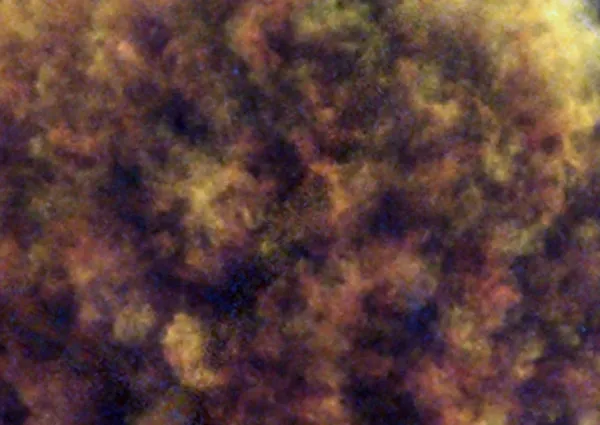
Bad hair day? The stuffing from your couch? Something from a Jacques Cousteau film?
None of the above. This is a really, really strange-looking thing when you look only at this close-up portion. In fact, it's a really, really strange-looking thing even when you see the full picture.
Just one very unhelpful hint today: The name of this is as strange as the look. Read on to find out what it is and see the cosmic blue highlights …
It's what astronomers sometimes call a zombie star. More precisely, it's an explosive remnant of a dead white dwarf star. So the star dies, gets real quiescent, then explodes as if out of nowhere and billows outward, pushing a shockwave in front.
The technical name is a Type Ia supernova. This one is called Tycho's supernova remnant, named for the astronomer who Danish astronomer Tycho Brahe, who in 1572 saw the bright light from its explosion. It was so bright it was visible in the day time with the naked eye — only Venus, among all planets and stars in our sky these days, gets that bright.
Tycho's supernova remnant, Tycho for short, was first seen from Earth in 1572 when, as an exploding star, it was so bright it was visible during the day.
(Image credit: NASA/CXC/Chinese Academy of Sciences/F. Lu et al)
Tycho, as it's often referred to, is within our Milky Way galaxy, about 13,000 light-years from Earth. Other pictures of Tycho's supernova show it in different colors (taken in different wavelengths of light), but they all reveal the same odd look of a bushy head of hair. Here's one more.
Got a strange or interesting photo related to science, nature or technology? What the Heck, send it to me, and maybe I'll use it.
Sign up for the Live Science daily newsletter now
Get the world’s most fascinating discoveries delivered straight to your inbox.
Robert is an independent health and science journalist and writer based in Phoenix, Arizona. He is a former editor-in-chief of Live Science with over 20 years of experience as a reporter and editor. He has worked on websites such as Space.com and Tom's Guide, and is a contributor on Medium, covering how we age and how to optimize the mind and body through time. He has a journalism degree from Humboldt State University in California.