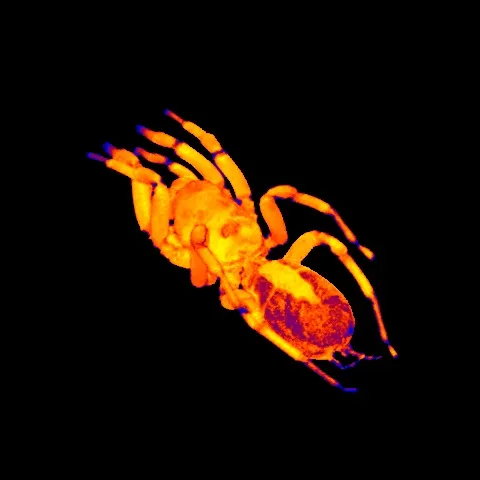
Researchers have recorded the first real-time images of a tarantula's heart beating.
The video, captured with magnetic resonance imaging, or MRI, reveals how blood moves through the tarantula's heart, said study researcher Gavin Merrifield, a University of Edinburgh doctoral candidate.
"In the videos, you can see the blood flowing through the heart, and tantalizingly, it looks as though there might be 'double beating' occurring, a distinct type of contraction which has never been considered before," Merrifield said in a statement.
A still from the MRI video of the tarantula's heart beating.
(Image credit: Gavin Merrifield)
The MRI allowed researchers to measure the spider's heart rate and cardiac output (how much blood it pumps per beat) noninvasively as part of an ongoing study of tarantula biology. [See images of the tarantula's heart]
A sedated tarantula in an MRI machine
(Image credit: Gavin Merrifield)
"One potential practical use of this research is to ascertain the chemical composition of spider venom. Venom has applications in agriculture as a potential natural pesticide," Merrifield said.
"On the more academic side of things, if we can link MRI brain scans with a spider's behavior and combine this with similar data from vertebrates, we may clarify how intelligence evolved."
You can follow LiveSciencesenior writer Stephanie Pappas on Twitter @sipappas. Follow LiveScience for the latest in science news and discoveries on Twitter @livescienceand on Facebook.
Sign up for the Live Science daily newsletter now
Get the world’s most fascinating discoveries delivered straight to your inbox.
For the science geek in everyone, Live Science offers a fascinating window into the natural and technological world, delivering comprehensive and compelling news and analysis on everything from dinosaur discoveries, archaeological finds and amazing animals to health, innovation and wearable technology. We aim to empower and inspire our readers with the tools needed to understand the world and appreciate its everyday awe.