














Japan Quake Raises Shaking Risk Elsewhere in Country

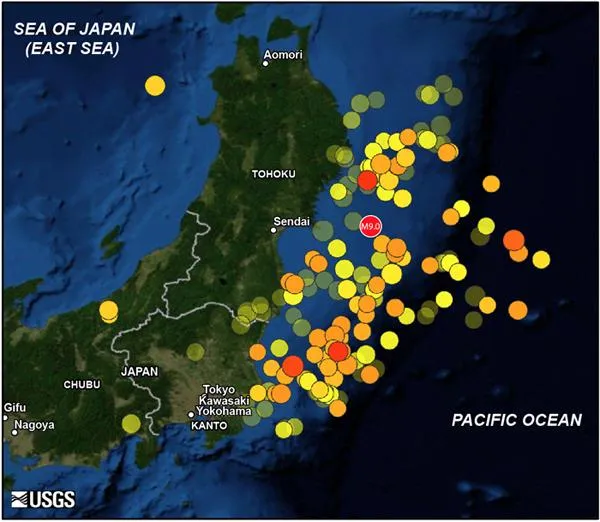
The massive 9.0 magnitude earthquake that devastated Japan in March built up stress on other faults in the country, putting some areas, including Tokyo, at risk of aftershocks and even new main shocks over the next few years, scientists have found.
After studying data from Japan’s extensive seismic network, researchers from the Woods Hole Oceanographic Institution (WHOI), Kyoto University and the U.S. Geological Survey (USGS) have identified several areas at risk from the quake, Japan's largest ever, which already has triggered a large number of aftershocks.
Data from the Tohoku earthquake on March 11 has brought scientists a small step closer to a better assessment of future seismic risk in specific regions, said Shinji Toda of Kyoto University, a lead author of the study.
"Even though we cannot forecast precisely, we can explain the mechanisms involved in such quakes to the public," he said. Still, he added, the findings do bring scientists "a little bit closer" to being able to forecast aftershocks.
The earthquake relieved stress along the part of the fault where it ruptured, decreasing the likelihood of such a temblor happening in the future, but only in some areas. On neighboring portions of the fault or on nearby, different faults, the possibility of an earthquake may have risen, the scientists found.
The quake, the fourth-largest earthquake ever recorded, was also one of the best-recorded quakes in history because of Japan's extensive seismic monitoring network. [Related: Why the Japan Tsunami Was so Big]
This made the quake a "special" one in terms of scientific investigation, Jian Lin of WHOI said in a statement. "We felt we might be able to find something we didn't see before" in previous quakes, he said.
Get the world’s most fascinating discoveries delivered straight to your inbox.
The magnitude 9 quake appears to have influenced large portions of Honshu Island, Toda said. At particular risk, he said, are the Tokyo area, Mount Fuji and central Honshu, including Nagano.
The Kantu fragment, which is close to Tokyo, also experienced an increase in stress. Previous government estimates have put Tokyo at a 70 percent risk for a magnitude 7 earthquake over the next 30 years. The new data from the Tohoku quake increased those odds to "more than 70 percent," Toda said. "That is really high."
Using a model known as Coulomb stress triggering, Lin and his colleagues found measureable increases in stress along faults to the north at Sanriku-Hokobu, south at Off Boso and at the Outer Trench Slope faults east of the quake’s epicenter off the Japan coast near the city of Sendai. "Based on our other studies, these stress increases are large enough to increase the likelihood of triggering significant aftershocks or subsequent main shocks," the researchers wrote in their study.
"There remains a lot of real estate in Japan — on shore and off — that could host large, late aftershocks of the Tohoku quake," said Ross S. Stein of USGS.
This story was provided by OurAmazingPlanet, sister site to LiveScience.
