













Golf Balls Made from Lobster Shells? Only in Maine

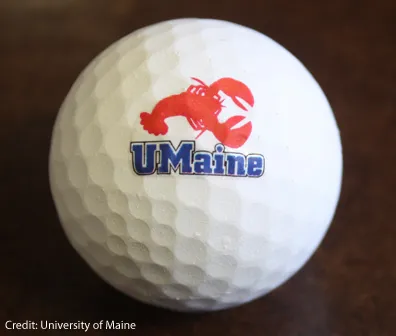
Researchers at the University of Maine have engineered golf balls that look and feel pretty much like, well, golf balls, except that these ones are made of lobster shells.
The biodegradable balls are intended for use on cruise ships, where hobby golfers whack hundreds of thousands of golf balls out to sea each year. Golf ball littering is a big problem on land, too: In the United States alone, an estimated 300 million balls are lost or discarded annually. Traditional golf balls take up to a millennium to decompose.
Biodegradable golf balls already exist, but the Mainers' version is the first to attack an additional problem by helping eliminate lobster waste.
"The University of Maine is a land grant institution, so we consider it our mission to serve the people and industries of the state," Neivandt told Life's Little Mysteries, a sister site to LiveScience. "Anything we can do to aid the lobster industry in particular is something the university considers an important part of its function, so we're trying to turn something from the industry's waste stream into a value added product."
The raw material needed to mold a single ball costs only 19 cents, "so we'd project it would come in at well under a dollar per ball, and be cost competitive with other biodegradable balls on the market," Neivandt said. He and UMaine administrators are currently investigating the best route to commercialization.
The lobster balls work fine, too. "The flight properties are amazing," undergraduate research assistant and amateur golfer Alex Caddell said in a press release. "It doesn't fly quite as far as a regular golf ball, but we're actually getting a similar distance to other biodegradable golf balls." On a cruise ship, Neivandt explained, it doesn't matter how far golf balls go anyway: "The primary reason people do it is to practice their swing. I don't think a small decrease of distance off a driver is important in that location."
UMaine has filed a provisional patent for the lobster shell and biodegradable polymer mixture used to make the balls. The material might also be utilized for products such as plant pots that decompose in the ground and surveying stakes, the researchers said.
Get the world’s most fascinating discoveries delivered straight to your inbox.
This article was provided by Life's Little Mysteries, a sister site to LiveScience. Follow Natalie Wolchover on Twitter @nattyover.

Natalie Wolchover was a staff writer for Live Science from 2010 to 2012 and is currently a senior physics writer and editor for Quanta Magazine. She holds a bachelor's degree in physics from Tufts University and has studied physics at the University of California, Berkeley. Along with the staff of Quanta, Wolchover won the 2022 Pulitzer Prize for explanatory writing for her work on the building of the James Webb Space Telescope. Her work has also appeared in the The Best American Science and Nature Writing and The Best Writing on Mathematics, Nature, The New Yorker and Popular Science. She was the 2016 winner of the Evert Clark/Seth Payne Award, an annual prize for young science journalists, as well as the winner of the 2017 Science Communication Award for the American Institute of Physics.