













Hybrid Creatures: The Real Science of 'Splice'

For some people the word "hybrid" means a fuel-efficient car. For others, however, it conjures up visions of monsters.
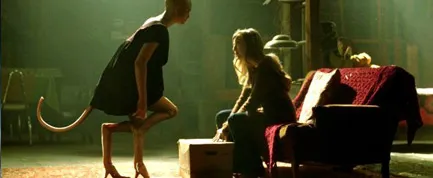
The new thriller "Splice," opening June 4, tells the story of two world-class genetic engineers who specialize in splicing together DNA from different animals to create amazing new hybrids. Though fantastically successful with their animal hybrids, they secretly create a new human-animal hybrid creature that could yield a cure for cancer and other diseases. But as any movie buff knows, scientists who play God with life find that things go horribly wrong.
This theme, of course, is not new. Depictions of mad scientists creating unholy hybrid monsters can be traced back to the 1896 H.G. Wells novel "The Island of Dr. Moreau" and Mary Shelley's 1818 novel "Frankenstein; Or, the Modern Prometheus." Films like "Splice" draw upon a widespread and deep-seated public distrust of scientists; this same distrust (rightly or wrongly) also underlies concerns over genetically modified organisms.
There exist rumors and urban legends of supposed human/chimpanzee hybrids ("humanzees"), and though humans and chimpanzees are more genetically alike than not, no evidence of such a hybrid exists, and scientists doubt it is possible.
Human/animal hybrids are merely the stuff of horror fiction — and Internet hoaxes; a photo of a supposed half-human, half-dog family circulated around the Web in 2009 — though hybrids are not uncommon in the animal kingdom. [8 bizarre hybrid animals.]
One of the most familiar animal hybrids is the mule, which is the product of a male donkey and a female horse. Another pair of celebrated hybrids are ligers (a male lion and a female tiger) and tigons (a female lion and a male tiger) which have characteristics of both species.
Despite images of Frankenstein's monster, there's not necessarily anything unnatural about hybrids; in fact they often occur in nature.
Get the world’s most fascinating discoveries delivered straight to your inbox.
Members of Canid family (which includes dogs, wolves, coyotes, and foxes) are well known for interbreeding and creating hybrids. And scientists in Canada's Northwest Territories recently announced that they found the first confirmed hybrid between polar and grizzly bears. A hunter killed an unusual-looking bear and submitted its meat to scientists; genetic analysis revealed that the hybrid's mother was a polar-grizzly mix, its father a grizzly.
While cinematic scientists such as those in "Splice" unwittingly unleash horrific monsters, real genetic scientists strive to help create hardier and healthier plant and animal hybrids. Drs. Frankenstein and Moreau need not apply.
Benjamin Radford is managing editor of the Skeptical Inquirer science magazine. He is co-host of the MonsterTalk podcast, and his new book Scientific Paranormal Investigation has just been released; this and his other books and projects can be found on his website. His Bad Science column appears regularly on LiveScience.
