













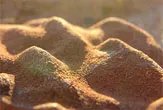
They resemble upside-down ice cream cones or egg cartons, but a new analysis suggests that the odd sedimentary structures found in Western Australia are among the earliest signs of life on the planet.
Called "stromatolites," the structures are believed to be about 3.4 billion years old. Since they were first described nearly 30 years ago, scientists have see-sawed between attributing them to the work of ancient microbes or hydrothermal vent activity.
But in a new study detailed in the June 8 issue of the journal Nature, Australian researchers argue that the shapes of the stromatolites are too complex and diverse to have been formed by physical processes.
Turned to stone
Abigail Allwood of Macquarie University in Sydney and colleagues analyzed a 6-mile stretch of the rock formations and identified seven different types of stromatolites. Aside from ice cream cones and egg cartons, the researchers also found stromatolites that look like fossilized sand dunes or choppy ocean waves that have been frozen and turned to stone.
The researchers believe the eclectic mix of stromatolites was formed not by one creature, but many.
Allwood said her team was able to recover a few scraps of organic matter from the site which they will begin analyzing soon. The sample is so small, however, that it is difficult to say much more about the organisms that made the stromatolites than that they were microbial, Allwood told LiveScience.
Get the world’s most fascinating discoveries delivered straight to your inbox.
New thinking
If the stromatolites do turn out to have a biologic origin, it could change how scientists think about life on early Earth. Many current theories about early life state that the first organisms arose around hydrothermal vents and other extreme environments. But the Australian stromatolites are thought to have formed in relatively normal marine conditions.
If the stromatolites were formed by microbes, then life must have adapted to normal, non-extreme environments even as early in the planet's history as 3.4 billion years ago. Earth is about 4.5 billion years old. Furthermore, life by that time would have already diversified enough to form complex ecosystems.
"We hope this will move us beyond the question of whether or not life simply 'existed' at the time to looking at the conditions that nurtured early ecosystems," Allwood said.