













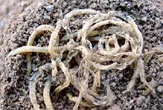
Archeologists excavating an ancient Chinese settlement discovered a small pile of well-preserved noodles after turning over an upside-down clay bowl.
The bowl was buried beneath 10 feet of sediment in Lajia, a small community located by the Yellow River in northwestern China that was destroyed by an earthquake about 4,000 years ago.
The thin, yellow noodles were about 20 inches long and resembled La-Mian, a type of traditional Chinese noodle made by grinding wheat to make dough and then repeatedly pulling and stretching the dough by hand.
The finding is reported in the October 13 issue of the journal Nature.
Prior to the discovery, the earliest mention of noodles was in a 1,900 year old book written during the East Han Dynasty in China, said Lu Houyuan, an archeologist from the Chinese Academy of Sciences who was involved in the discovery.
When the archeologists examined the starch grains and microscopic mineral particles that form in plants called "phytoliths," they received another surprise: the ancient noodles were not made from wheat like modern noodles, but from millet, a type of grain that, along with rice, formed the foundation of agriculture in ancient China.
"Archaeological evidence suggests that even though wheat was present in northwestern China 5,000-4,500 years ago, it wasn't commonly cultivated until much later," Huoyuan said in an email interview.
Get the world’s most fascinating discoveries delivered straight to your inbox.
"It took a long time for wheat to become successfully naturalized in China," Houyuan told LiveScience. "It gradually spread from northwestern China to the East and to the South."
It was only much later, during the Tang Dynasty and the Song Dynasty, from 618 to 1279 AD, that wheat began to catch on with people in China, finally becoming the second largest staple grain crop in the country after rice.
- Waxy Wheat Lasts Longer
- Blinded by Carbohydrates
- Deadly Earthquakes