













Baby Marine Reptile Buried by Volcano

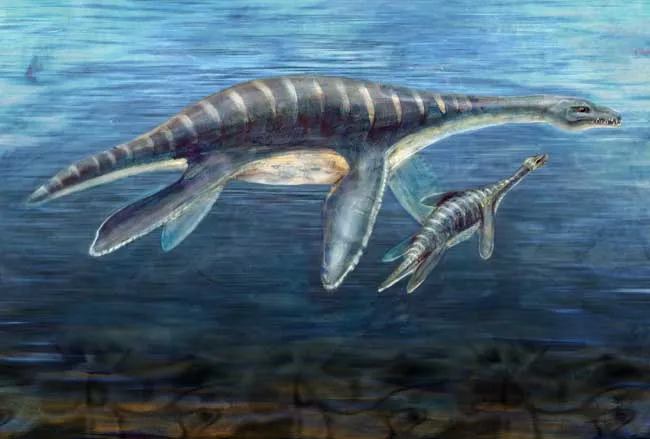
A massive volcanic blast may have killed and preserved a baby marine reptile, whose skeleton, one of the most complete example of its kind ever found, was recovered from the frozen ground of Antarctica.
Plesiosaurs, ancient marine reptiles with paddle-like fins, swam through the Southern Ocean approximately 70 million years ago, when Earth’s oceans were far warmer than they are today [image].
The 5-foot-long skeleton recovered by the team is believed to be that of a baby plesiosaur, as its bones had not yet developed distinct ends. Adult plesiosaurs could reach more than 32 feet in length [image / video].
The stomach area of the fossil was remarkably well-preserved, and scientists found many small, rounded stones called gastroliths in the abdominal cavity. The stones could have been swallowed by young plesiosaurs to help them maintain buoyancy or to help them digest their food.
Volcanic ash was found layered in with marine sands at the site [image]. The researchers suspect that a massive eruption on the scale of Mt. St. Helens in 1980 dumped ash into the ocean, causing the death of the baby plesiosaur. Silica release from the ash preserved the skeleton.
The skull of the animal had eroded away from its body, but because of the 70 mile per hour winds at the site on Vega Island, the team was unable to look for it.
Since 1998, the team has uncovered numerous remains of plesiosaurs and mosasaurs, a giant marine reptile resembling an alligator with fins. During this most recent trip, the researchers found two other plesiosaur fossils and remains of very advanced shore birds.
Get the world’s most fascinating discoveries delivered straight to your inbox.
The researchers believe the site where the baby plesiosaur was recovered could have been a shallow-water birthing and nursery ground where young plesiosaurs stayed until they could survive on their own in open waters.
- Video: See the Young Beast Swim
- How the Real 'Loch Ness Monster' Swam
- Newfound Reptile Swam in Dinosaur Era
- Image: Ancient Swimming Reptiles Uncovered
- Images: Dinosaur Fossils
- All About Dinosaurs
- Dinosuar Art

Andrea Thompson is an associate editor at Scientific American, where she covers sustainability, energy and the environment. Prior to that, she was a senior writer covering climate science at Climate Central and a reporter and editor at Live Science, where she primarily covered Earth science and the environment. She holds a graduate degree in science health and environmental reporting from New York University, as well as a bachelor of science and and masters of science in atmospheric chemistry from the Georgia Institute of Technology.