













Crashing Electrons Could Explain Earth's Magnetic Field Mystery

A messy paradox that has plagued geoscientists who study Earth's core and the magnetic field it produces may now be solved.
The puzzle is only a few years old. It was raised in a 2012 paper in which geophysicists in the United Kingdom published a widely accepted supercomputer model that found Earth's iron core was incredibly efficient at conducting heat. In conduction, heat moves, but the material transferring the heat stays still — think of a kitchen pan warming up. The transfer of the heat from the stovetop to the pan is conduction.
In that study, the researchers examined how heat may move through the Earth's core, at the level of atoms and electrons. Put simply, the paradox is that in this model, so much heat escaped from the core via conduction that there wasn't enough energy left over to fuel convection (when heat creates motion) in the liquid outer core. The implication: Earth's magnetic field shouldn't exist. (If kitchen pans were as effective at conducting heat as the core, then meat would never cook because all the heat would escape into the air.)
"The study attracted a lot of attention because of the serious consequences," said Bruce Buffett, a geophysicist at the University of California, Berkeley, who was not involved in the research.
But now, new research finds that inside the deep Earth, where temperatures can match those on the surface of the sun, iron's electrons move heat by more means than just the usual way, through rapid vibrations, according to a study published today (Jan. 28) in the journal Nature. Electrons also bash into one another, transferring energy through collisions known as electron-electron scattering. [What Is Earth Made Of?]
The results resolve the paradox, the researchers concluded in the new paper. "There was a big problem in how you generate a magnetic field, and now, because of our results, that problem has basically gone away," said study co-author Ron Cohen, a staff scientist at the Carnegie Institution for Science in Washington, D.C., and a professor at University College London in the United Kingdom.
Shiver and shake
Get the world’s most fascinating discoveries delivered straight to your inbox.
Lead study author Peng Zhang, also of the Carnegie Institution, used a National Science Foundation supercomputer to calculate how iron's electrons zip and zwing within the core. The modeling work is akin to predicting to position of every water droplet in a rain cloud, Cohen said. "We're worrying about where every single electron is, and how they interact and scatter and bounce off each other," Cohen told Live Science.
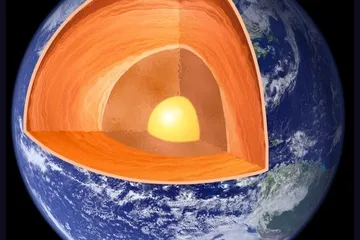
The Earth's inner core is solid, and about the size of the moon. The outer core is liquid; about 1,400 miles (2,250 kilometers) thick; and topped by 1,800 miles (2,900 km) of crystalline mantle that flows like warm plastic. This is all encased in a cold, hard shell of rock called the crust. The core is not pure iron metal — elements such as oxygen, carbon and nickel are also present.

Zhang's team discovered that in the core, collisions between electrons are as important as collisions between electrons and vibrating atoms (known as electron-phonon scattering) when it comes to heat energy. The earlier modeling work, also published in Nature, had concluded that the Earth's core is losing two to three times as much heat to conduction than previously thought. Zhang's new findings put the amount of lost heat back in line with conventional models (because accounting for the electron-electron collisions gives iron a lower conductivity).
Laboratory experiments can determine whether the team's model is correct, Cohen said.
"These calculations are difficult, as are the experiments, but confirmation of these results will be important," said Dave Stevenson, a geophysicist at the California Institute of Technology who was not involved in either study. However, he said, it is not yet clear that the new results overturn the earlier findings from 2012.
"Science is never that simple," Stevenson said. And the new study won't solve all the questions that remain, such as how the Earth actually cooled throughout its history, Stevenson said.
Protecting the planet
Since the 2012 model was published, geoscientists have come up with alternate explanations for how Earth's magnetic field may work,under the premise that most heat was escaping through conduction. The planet's magnetic field has existed for at least 3.4 billion years, according to magnetic minerals in ancient rocks.
Convection is when heat creates motion. Heat from below causes material to rise, and as the material cools, it falls back down again — just like you see in a pot of boiling water or when all the hot air in a room collects near the ceiling. Scientists think that convection currents in the core's liquid metal may flow in spirals due to Earth's constant rotation. The spiraling metal generates the planet's magnetic field. Without a magnetic field, Earth would have no protection from the the solar wind, and life as we know it wouldn't exist. [Photo Timeline: How the Earth Formed]
One alternate way to explain the magnetic field, that doesn't require heat-driven convection, holds that the convection is driven by changes in composition inside of the Earth. The inner core started forming about 1 billion years ago, when temperatures finally dropped low enough for iron metal to freeze solid, scientists think. As iron continues to solidify, lighter elements in the metal mixture, such as oxygen and carbon, may escape and rise toward the mantle, fueling convection currents.
It's also possible that a heat-driven magnetic field, or geodynamo, existed before the inner core formed, said Monica Pozzo, a geophysicist at University College London and leader of the 2012 modeling work.
"A sure impact of this [new] work will be to intensify the current debate on the thermal history of the Earth and the workings of the geodynamo," Pozzo said.
Follow Becky Oskin @beckyoskin. Follow Live Science @livescience, Facebook & Google+. Originally published on Live Science .
