














Modern Worldwide Danger Blooms from Ancient Bacteria
This Behind the Scenes article was provided to Live Science's Expert Voices: Op-Ed & Insights in partnership with the National Science Foundation.
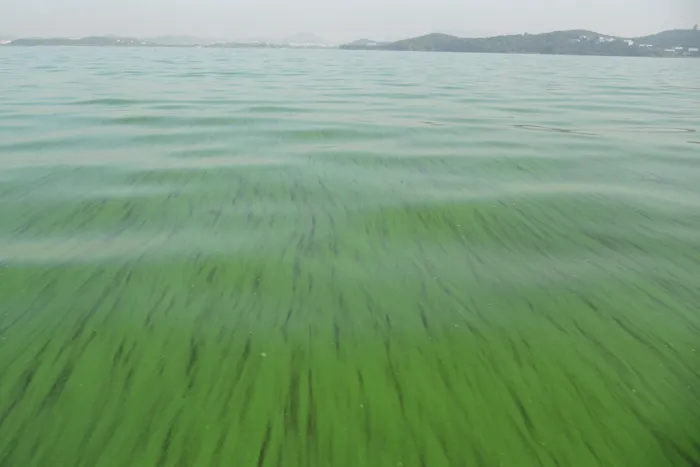
Cyanobacteria, also known as blue-green algae because of their color, have endured for more than 2.5 billion years, providing ample time to adapt to changes in the Earth's biosphere. They live in water where a diet heavy in nitrogen and phosphorus, combined with global warming, can prompt them to produce slimy toxic blooms that make the water unfit for drinking, agriculture and recreation.
"Human activities have dramatically increased nitrogen and phosphorus inputs into many rivers and lakes, causing algal blooms that threaten economic and recreational uses of those waters," says Hans Paerl, professor of marine and environmental sciences at the University of North Carolina-Chapel Hill Institute of Marine Sciences. "This nutrient over-enrichment in freshwater has led to a global proliferation of cyanobacterial blooms which foul the water, disrupt food webs, reduce oxygen, and produce metabolites toxic to fish, zooplankton, cattle, domestic pets and humans.''
Humans who drink the water or eat its fish or shellfish can suffer damage to the liver, intestines and nervous system. Moreover, while still unknown, the possibility exists that "using this water for irrigation of edible crops could potentially lead to toxins being transferred into consumable foods, since they don't break down easily," Paerl says.
The major sources of nitrogen and phosphorus that enter these water systems and feed the cyanobacteria include runoff from chemical fertilizers, factories, urban impervious surfaces and waste water treatment facilities, and air pollution from fossil fuel and automobile combustion to create "a perfect soup'' of noxious blooms, he says, adding: "We are now having to pay back Mother Nature for all those cultural advances."
Paerl currently is leading an international team of researchers working to better understand and help restore the ecosystem balance in Lake Taihu, the third largest lake in China, a once pristine lake where severe toxic blooms now grow regularly, and which serves as a major source of drinking water for more than 10 million people. "So, the stakes are huge," Paerl says.
Research with a Global Impact
Get the world’s most fascinating discoveries delivered straight to your inbox.
Beyond China, however, insights gleaned from their research almost certainly will have an impact on the management of global waterways, including in the United States, where harmful cyanobacterial blooms resulting in tainted water cause an estimated annual loss of more than $2 billion, according to Paerl and his research colleagues. They threaten some of the world's largest lake ecosystems, including the Great Lakes, and Lakes Okeechobee and Pontchartrain in North America, as well as the large lakes of Africa, Asia and South America.
"Lake Taihu serves as a looking glass for large lake ecosystems threatened by proliferating cyanobacterial blooms,'' he says. "While events in China may seem half-way-around-the-world relative to local concerns, they are in fact a potential foreshadowing for North American waterways."
The Lake Taihu work includes two collaborative projects funded by grants from the National Science Foundation totaling about $2 million.
One major goal of the research is to determine a nutrient threshold, that is, the level of nutrients in a body of water that would prevent toxic blooms from developing. The aim is to know how much to reduce those nutrients, nitrogen in particular. "It turns out we've done a good job reducing phosphorus, but have not been paying enough attention to nitrogen,'' Paerl says. "We are now literally drowning in nitrogen entering our waterways from land and the atmosphere."

Climate Change is Making Things Worse
Climate change is complicating the calculations, since the microorganisms seem to thrive in warm temperatures. "Cyanobacteria love warm weather," Paerl says. "Many of the cyanobacterial blooms typically occur in summertime. Warmer weather will increase the probability that these blooms will become dominant."
Thus, nutrient thresholds likely will need to become lower as the weather becomes warmer. "If you get below a certain threshold, the chances for these blooms to dominate decreases," he says. "But if you increase the temperature at the same time, then the threshold will change too. So we might have to reduce the threshold even more. We are designing a nutrient reduction strategy for whatever the temperature is going to be now, but we may need to revisit the strategy and crank down on the nutrients even more in the future."
The scientists' experiments involve collecting lake water from different locations and adding nutrients in different concentrations to transparent containers, which vary in size from a few liters (microcosms) to more than 1,000 liters (mesocosms), while leaving others untouched to serve as controls for comparative purposes. "We compare the growth in the nutrient additions to the controls, then put the containers back into the lake," Paerl explains, adding that setting up the experiment occurs over several hours on the same day.
"Over time, we monitor algal growth and compare the stimulatory effects of nitrogen and phosphorus, taking into account all the other environmental factors that can control growth like light and temperature,'' he continues. "We conduct these experiments over periods ranging from a few days to several weeks. From that, we can estimate the growth potential of these nutrients over a range of concentrations reflecting varying levels of enrichment from the watershed."
The team also is conducting experiments "where, instead of adding nutrients, we remove them by adding artificial lake water that is missing the nutrients,'' he says. "The idea is to predict what will happen when we reduce nutrient inputs to the lake."
Finally, the researchers are also trying to characterize the organisms already in the water because "we want to know who the players are,'' he says. "The reason we are interested in that is because we need to know how the microbial diversity is changing in the lake.
We want to encourage the growth of good as opposed to bad players. It's not just that these blooms are ugly and discourage tourists, but they produce toxins and more than 10 million people use the lake for drinking water."

Bacteria Not Algae
Despite the misnomer "blue-green algae," cyanobacteria are not algae, but bacteria. They are prokaryotic, meaning they lack a nucleus, unlike traditional algae. Cyanobacteria perform photosynthesis just like traditional algae, but they prefer warm conditions, unlike true algae groups, which reach peak growth rates at lower temperatures.
"Cyanobacteria are unique in that they are the only bacterial group capable of oxygen-evolving photosynthesis." Paerl says. "This has had major ramifications for evolution of life on Earth, in particular oxygenation of the atmosphere, starting some two billion years ago. This transformation has provided opportunities for higher plants and animals, including human, to inhabit our planet. So, the influence of cyanobacteria on Earth is two-sided from a human perspective — both good and bad."
The researchers depicted in Behind the Scenes articles have been supported by the National Science Foundation, the federal agency charged with funding basic research and education across all fields of science and engineering. See the Behind the Scenes Archive. Follow all of the Expert Voices issues and debates — and become part of the discussion — on Facebook, Twitter and Google +. The views expressed are those of the author and do not necessarily reflect the views of the publisher. This version of the article was originally published on Live Science.