













Small Islands Amplify Tsunami Flooding

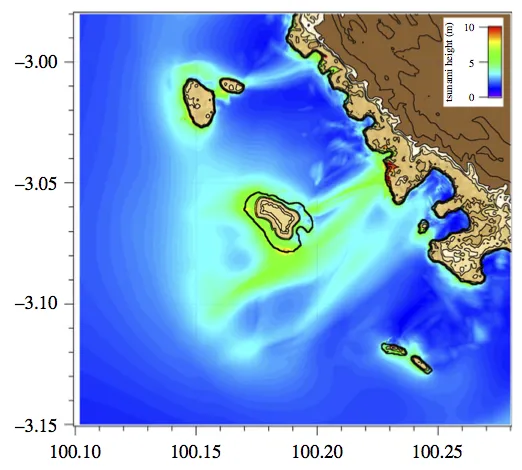
Small offshore islands help protect beaches from storm waves, but they're no match for tsunamis. It turns out that small islands boost the power of big tsunami waves, rather than absorbing their impact, a new study shows. In a computer model, a small island amplified tsunami flooding directly behind it by up to 70 percent.
"Our study shows that some areas that were supposed to be at low risk are at higher risk than anticipated," said study co-author Frederic Dias, an ocean wave expert at University College Dublin in Ireland. The findings were published today (Nov. 5) in the journal Proceedings of the Royal Society A.
Tsunami waves in the ocean are generated by the sudden motion of the seafloor or by underwater landslides. The rapid movement is like a giant paddle stroke that creates a series of huge ripples that transform into terrifying waves closer to shore. The length between the top (or crest) of each wave can be as much as 100 miles (160 kilometers). [10 Tsunamis That Changed History]
Experts predict the risk of flooding and damage from deadly tsunami waves based on many factors, such as the shape of coastlines, bumps and ridges on the seafloor and where the tsunami originated. Plugged into computer models, these factors spit out a tsunami run-up, an estimate of the maximum elevation that water will deluge the coast. In the last two decades, scientists have noted several cases of unusually high tsunami run-ups behind small islands, Dias said.
"The key word is small," Dias told Live Science. Big islands or long sandy barrier islands both offer protection against tsunamis, he said. For example, the 2010 Sumatra earthquake spawned a tsunami that battered the Mentawai Islands along Sumatra's west coast. Small islands had high run-ups behind them, but larger islands shielded the western Sumatra mainland, according to a June 5, 2012, study in the Journal of Geophysical Research. In this case, islands about 6 miles (10 km) wide were considered small, and the largest island was about 68 miles (110 km) long.
"If you have a long island and a long wave, or a short island and a short [storm] wave, the protection will be there," Dias said. "The amplification of run-up is observed just on the areas behind small islands."
The researchers studied the effects by simulating a tsunami wave hitting a conical island a couple miles wide and a couple miles long (a few km on each side) sitting near a straight, long beach. An algorithm that learned from the results of each model run helped fine-tune the simulation. After running 200 tests, the researchers, led by Themistoklis Stefanakis of University College Dublin, discovered every simulation had intensified tsunami flooding.
Get the world’s most fascinating discoveries delivered straight to your inbox.
When a long-wavelength tsunami wave hits a small island, the waves slightly bend around and meet behind it, focusing their energy and amplifying the run-up onshore. (This is similar to the diffraction effect that lets low-frequency sound waves rumble around corners.) "The big surprise was in all cases we got an increase in run-up," Dias said.
The researchers suggest that tsunami hazard models that ignore the effect of small islands could underestimate the impact of potential flooding. Dias said he and his colleagues are part of an international group that is currently updating the Atlantic and Mediterranean operational models for tsunami prediction, which provide real-time estimates of run-up from an approaching tsunami.
Follow Becky Oskin @beckyoskin. Follow LiveScience @livescience, Facebook & Google+. Originally published on Live Science.
