













How Einstein's E=mc^2 Works (Infographic)

Updated Tuesday, May 20, at 1:35 p.m. ET
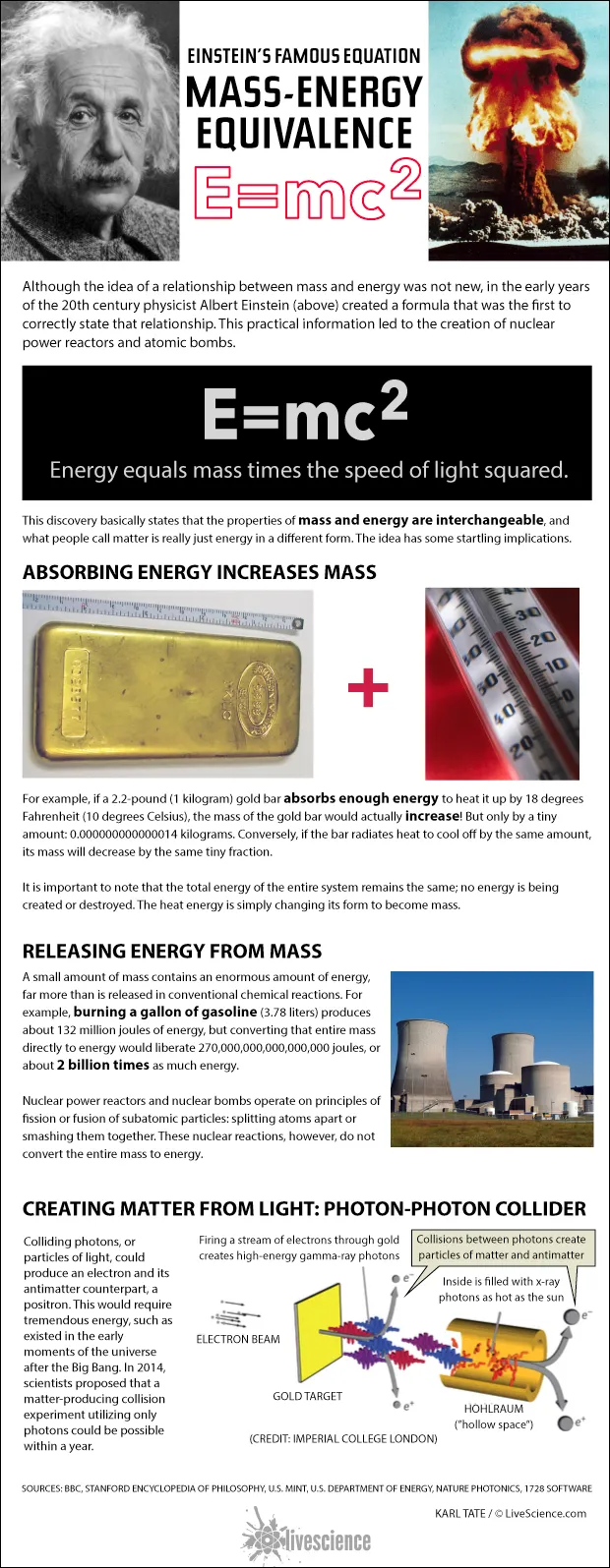
Although the idea of a relationship between mass and energy was not new, in the early years of the 20th century, physicist Albert Einstein created a formula that was the first to correctly state that relationship — E=mc^2. This practical information led to the creation of nuclear power reactors and atomic bombs.
This discovery basically states that the properties of mass and energy are interchangeable, and what people call matter is really just energy in a different form. The idea has some startling implications.
For example, if a 2.2-pound (1 kilogram) gold bar absorbs enough energy to heat it up by 18 degrees Fahrenheit (10 degrees Celsius), the mass of the gold bar would actually increase! But only by a tiny amount: 0.000000000000014 kilograms. Conversely, if the bar radiates heat to cool off by the same amount, its mass will decrease by the same tiny fraction.
It is important to note that the total energy of the entire system remains the same; no energy is being created or destroyed. The heat energy is simply changing its form to become mass.
Get the world’s most fascinating discoveries delivered straight to your inbox.
A small amount of mass contains an enormous amount of energy, far more than is released in conventional chemical reactions. For example, burning a gallon of gasoline (3.78 liters) produces about 132 million joules of energy, but converting that entire mass directly to energy would liberate 270,000,000,000,000,000 joules, or about 2 billion times as much energy.
Nuclear power reactors and nuclear bombs operate on principles of fission or fusion of subatomic particles: splitting atoms apart or smashing them together. These nuclear reactions, however, do not convert the entire mass to energy.
Colliding photons, or particles of light, could produce an electron and its antimatter counterpart, a positron. This would require tremendous energy, such as existed in the early moments of the universe after the Big Bang. In 2014, scientists proposed that a matter-producing collision experiment utilizing only photons could be possible within a year.
Editor's note: This infographic was updated to correct metric-to-Imperial unit coversions.
