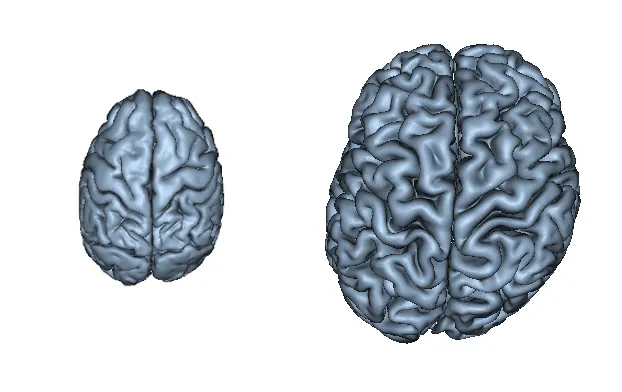
The two halves of the human brain are not symmetrical. This lopsidedness, which arises during brain development, may be a stamp of the adaptability of the human brain, a new study suggests.
Researchers compared geometric differences between brain scans of humans and chimpanzees. They observed structural asymmetries in both human and chimpanzee brains, but human brains were especially asymmetric. The findings, published online today (April 23) in the journal Proceedings of the Royal Society B, suggest human and chimp brains evolved a high degree of flexibility during development.
The human brain is known to be asymmetric — the "left brain" is involved in language processing, for example, while the "right brain" is where spatial reasoning takes place. "It's very common that there are some areas that are bigger in the left hemisphere than in the right hemisphere," said lead study author Aida Gómez-Robles, an anthropologist at The George Washington University in Washington, D.C. [10 Things You Didn't Know About the Brain]
Latest Videos From
Asymmetry and specialization of the brain's hemispheres were once thought be distinctly human traits, but primates and other animals possess them as well. The asymmetries take several forms: A population may have brains with one half that is consistently larger than the other, known as directional asymmetry; a population may consist of some individuals with one brain half larger and some with the other half larger, known as anti-symmetry; or a population can exhibit differences in both halves that differ from the average shape, known as fluctuating asymmetry.
Genetics is thought to play a role in the first two asymmetries. But scientists believe fluctuating asymmetry, in which individuals in a population possess a variety of differences in brain shape, may result when environmental factors affect the brain's development.
In their study, Gómez-Robles and her colleagues compared the differences between live human brains and chimpanzee brains using magnetic resonance imaging (MRI) scans. They processed the scans to obtain a 3D reconstruction of just the brain hemispheres. Then they used statistical techniques to map and compare the brain structures between individual humans and chimpanzees, as well as between the two species.
Both human and chimpanzee brains had asymmetries that varied across each population, the analysis showed. Compared with the chimpanzee brain, human brains showed even more variation in structure size between individuals in the population.
Overall, human brains had enlarged frontal and parietal lobes compared with chimp brains, as expected. Generally, chimps had relatively short and broad brain proportions, whereas humans had long and narrower proportions.
The pattern of brain variation seen in both humans and chimpanzees suggests this structural variation evolved in a common ancestor, enabling them to adapt to selective pressures in their environment.
The lack of symmetry in the brains of both animals, but especially humans, may be a sign of the flexibility, or plasticity, of their brains. "We know that plasticity is an important trait in the function of the brain," which is critical for human cognitive evolution, Gómez-Robles said. Being flexible allows the brain to adapt to the conditions of its environment, and this adaptation results in less symmetric brains.
It would be interesting to compare the results with the brains of other primates besides humans and chimpanzees, Gómez-Robles said, but this would require having skull MRIs (brain images) from those animals.
Follow Tanya Lewis on Twitter and Google+. Follow us @livescience, Facebook & Google+. Original article on Live Science.

 Live Science Plus