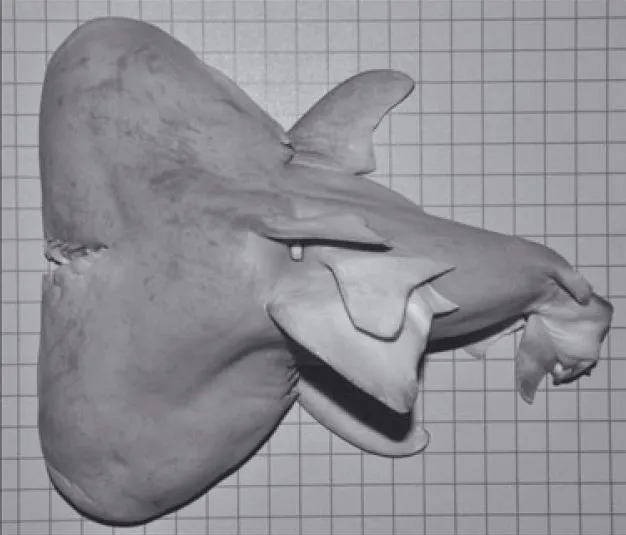
When a fisherman caught a bull shark recently off the Florida Keys, he came across an unlikely surprise: One of the shark's live fetuses had two heads.
The fisherman kept the odd specimen, and shared it with scientists, who described it in a study published online today (March 25) in the Journal of Fish Biology. It's one of the very few examples of a two-headed shark ever recorded — there about six instances in published reports — and the first time this has been seen in a bull shark, said Michael Wagner, a study co-author and researcher at Michigan State University.
Technically called "axial bifurcation," the deformity is a result of the embryo beginning to split into two separate organisms, or twins, but doing so incompletely, Wagner told OurAmazingPlanet. It's a very rare mutation that occurs across different animals, including humans.
"Halfway through the process of forming twins, the embryo stops dividing," he said.
The two-headed fetus likely wouldn't have lived for very long in the wild, he said. "When you're a predator that needs to move fast to catch other fast-moving fish … that'd be nearly impossible with this mutation," he said. [See the two-headed shark.]
Wagner said the description of the deformed shark may someday help better understand how these deformities arise in sharks and other animals.
Two-headed snakes and turtles can be bought from certain specialty breeders, and there is a small market for such creatures, Wagner said.
Sign up for the Live Science daily newsletter now
Get the world’s most fascinating discoveries delivered straight to your inbox.
Several of the few examples of two-headed sharks available today come from museum specimens from the late 1800s, when deformed animals and other macabre curiosities fetched high prices, he said.
Another reason the two-headed shark likely wouldn't have survived: its small body. "It had very developed heads, but a very stunted body," Wagner said. There's only so much energy that can go into the body's development, and it went into the shark's double noggins, he added.
A radiograph of the two-headed shark.
(Image credit: Journal of Fish Biology / C. M. Wagner et al)
Another photo of the two-headed bull shark fetus.
(Image credit: Patrick Rice, Shark Defense / Florida Keys Community College)
Douglas Main loves the weird and wonderful world of science, digging into amazing Planet Earth discoveries and wacky animal findings (from marsupials mating themselves to death to zombie worms to tear-drinking butterflies) for Live Science. Follow Doug on Google+.