













Gallery: Dreamy Images Reveal Beauty in Physics

Binary Droplet

A head-on collision between two water droplets just twice the thickness of a human hair results in this flattened pancake of fluid. Simulating such collisions allows researchers to understand how this sheet of liquid expands and contracts and how droplets splinter off its rim. [Read full story]
Cilia Flow

Coral polyps sport tiny hair-like appendages called cilia, which they beat rhythmically in the water. Researcher used fluorescent beads to track the flow of water around coral polyps, finding mixing that is perpendicular to the water surface. This fluid motion may enhance photosynthesis and protect the coral from nasty microbes. [Read full story]
Wet Clapping

Researchers inspired by watching children clap wet hands studied the dynamics of water "clapped" between two solid plates. They found that water flow outwards in a sheet with a thick rim, seen here. In another instant, the rim will begin to dissolve into fast-moving droplets. [Read full story]
Vortices Interact

Liquid vortices (red) interact with a solid wall to create secondary vortices (green). This research, sponsored by the Office of Naval Research, has practical applications for designing vehicles that move through air and water.[Read full story]
Plethora of Vortices

This whirlwind of vortices is created by water moving around a cylinder. [Read full story]
Cylinder Vortices

Water moving around a cylinder forms complex vortex patterns. [Read full story]
Beautiful Bubble

A burst of air in water creates this single bubble, photographed in multiple exposures as it rises to the top of the tank. Pressure differences between the top and bottom of the bubble transform it into a donut shape. [Read full story]
Get the world’s most fascinating discoveries delivered straight to your inbox.
Starfish Water
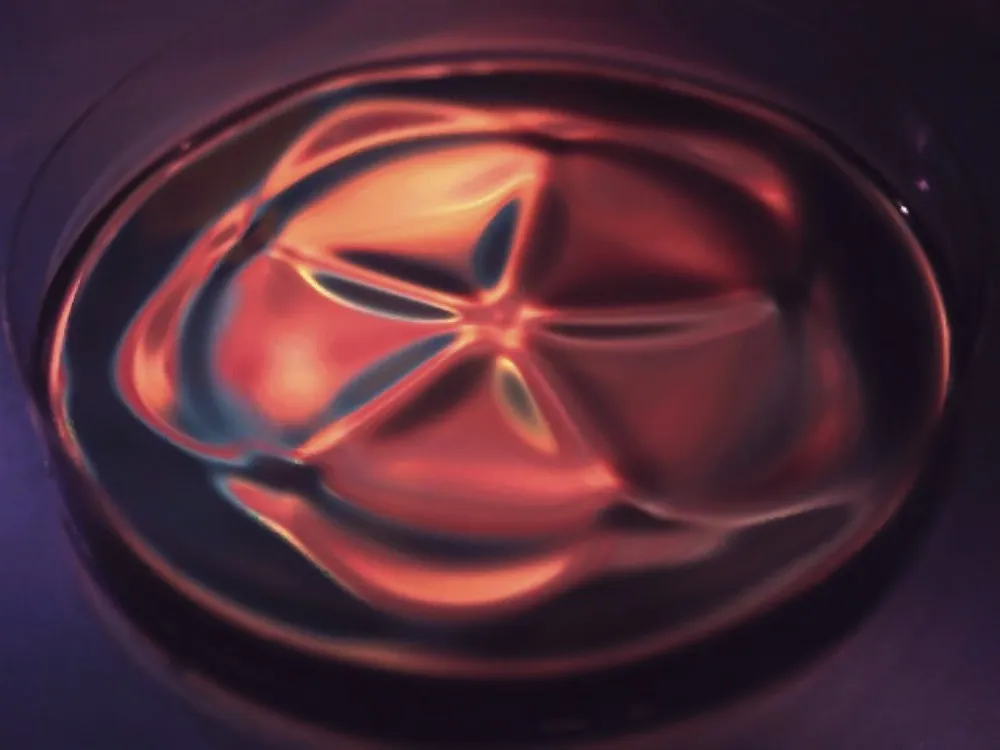
This starfish-shaped wave was created by vertically vibrating liquid in a container. The wave pattern alternates between looking like a star and looking like a pentagon. [Read full story]
Coiling Honey

A straight stream of honey coils as it his the surface of liquid water in a crystal goblet. This phenomenon is called "liquid rope coiling." [Read full story]
Water Feature

A specialized inlet and tube creates this disc of water, which would make a lovely addition to a garden fountain, researchers say. [Read full story]
Rinsing Flow

A beautiful blue-and-white mix of water and an elastic solution made of polyacrylamide, which is used in the process of making soft contact lenses. The image shows the water and the blue-dyed polyacrylamide undergoing a "hydraulic jump," which occurs when a fluid changes from a fast, parallel (or laminar) flow and moves into a slow, turbulent flow. [Read full story]

Stephanie Pappas is a contributing writer for Live Science, covering topics ranging from geoscience to archaeology to the human brain and behavior. She was previously a senior writer for Live Science but is now a freelancer based in Denver, Colorado, and regularly contributes to Scientific American and The Monitor, the monthly magazine of the American Psychological Association. Stephanie received a bachelor's degree in psychology from the University of South Carolina and a graduate certificate in science communication from the University of California, Santa Cruz.